
Short answer
AIC says a nursing home’s basic cost starts from S$3,900 a month before government subsidies. The amount a family eventually pays can be very different, because it depends on the resident’s care needs, citizenship or PR status, means-test result, insurance payouts and provider-specific charges. Do not treat a headline price as the final bill. Ask for a written, itemised quotation before accepting a place.
For many families, looking at a nursing home starts after a difficult change: a parent needs more help than can realistically be provided at home, a hospital discharge is approaching, or caregivers are exhausted. The financial question is immediate, but the right starting point is not simply, “Which home is cheapest?” It is: what level of care is required, what is included in the fee, what support may apply, and what would the family pay every month after those items are considered?
This ElderSG guide explains how to read the costs without promising an individual subsidy outcome or recommending a provider. It is designed to help you prepare for a conversation with a hospital medical social worker, AIC Link or a nursing-home admissions team.
Use this guide with: the Care Costs and Funding Planner, the Care Decision Navigator and the nursing-home directory.
What is included in a nursing-home fee?
A nursing home is a residential long-term-care service. A resident moves in and receives day-to-day support, nursing oversight and activities within the home. AIC describes nursing homes as an option for people who have a physical or mental disability from illness, cannot move around or manage daily living activities without help or supervision, and cannot be cared for at home even after other options have been tried.
The monthly fee is not a single universal package. It is usually based on the home, the resident’s care category or assessed needs, and the scope of services included. The basic fee may cover accommodation, meals, routine assistance with daily activities and standard nursing support. Depending on the home and a person’s needs, families may also encounter charges for items or services that are not included in the advertised starting fee.
When speaking with a provider, ask for the fee in writing and ask these questions plainly:
- What does the stated monthly fee include?
- What care category has been used for the quote, and can it change?
- Are diapers, feeds, wound-care supplies, specialist transport, medications, allied-health services or medical consultations charged separately?
- Is there a deposit, admission fee, administration fee or minimum stay?
- What happens to the fee if care needs increase?
- How often are fees reviewed, and how will families be told about changes?
The point is not to assume that every additional item will be charged. It is to prevent a family from comparing one home’s basic price with another home’s more comprehensive quote. An itemised quotation makes the comparison fairer.
The starting figure: S$3,900 before subsidies
At the time of writing, AIC states that the basic cost of nursing-home care starts from S$3,900 per month, depending on the level of care required, before government subsidies. AIC also notes that there may be additional fees, deposits and other charges depending on the nursing home.
That is a useful planning anchor, but it is not a prediction of your parent’s final payment. It should not be presented as a market average, a guaranteed rate, or a price that every nursing home offers. A person with more complex nursing needs may have a different fee from someone whose needs are lower. A private arrangement and a subsidised admission pathway may also lead to different conversations about fees and eligibility.
A simple way to think about the monthly bill
| Part of the picture | What to confirm |
|---|---|
| Provider’s assessed fee | The care category, what is included and when it can change |
| Government service subsidy | Whether the resident is eligible and the current means-test outcome |
| Insurance or cash payouts | CareShield Life, ElderShield or other relevant schemes, if eligible |
| MediSave Care | Whether severe-disability eligibility and balance rules are met |
| Family’s remaining payment | The estimated out-of-pocket amount after confirmed support |
| One-off costs | Deposit, admission charges, transport, supplies or other stated items |
Keep these as separate rows in your notes. A subsidy is not the same as an insurance payout; an insurer’s payout is not the same as a provider discount; and a provider cannot confirm a government eligibility decision on behalf of the agency. Separating them makes it easier to spot what has not yet been confirmed.
How nursing-home subsidies work in 2026
Singapore provides means-tested subsidies for eligible Singapore Citizens and Permanent Residents who receive care from MOH-funded long-term-care providers. Nursing-home subsidies are part of the residential long-term-care framework.
From 1 July 2026, MOH enhanced long-term-care subsidies. For residential long-term care such as nursing homes, the maximum subsidy for eligible Singapore Citizens is 75% for those born after 1969 and 80% for those born in or before 1969. The older cohort receives an extra 5 percentage points at every eligible income tier, and that uplift is already included in the 80% figure. Permanent Residents receive up to 50%. The rate that applies depends on monthly per-capita household income (PCHI), and households with PCHI above S$4,800 do not receive this subsidy.
| Monthly PCHI | Citizen born in or before 1969 | Citizen born after 1969 | Permanent Resident |
|---|---|---|---|
| S$0 to S$1,500 | 80% | 75% | 50% |
| S$1,501 to S$2,300 | 65% | 60% | 40% |
| S$2,301 to S$2,600 | 55% | 50% | 30% |
| S$2,601 to S$3,600 | 35% | 30% | 15% |
| S$3,601 to S$4,800 | 15% | 10% | 5% |
| Above S$4,800 | 0% | 0% | 0% |
Source: MOH, Subsidies for Residential Long-Term Care Services, effective 1 July 2026. Subsidy applies to the eligible portion of the fee at MOH-funded providers.
This does not mean every Singaporean receives 80%, or that a family can calculate its exact bill from the table alone. The applicable subsidy depends on the current official assessment. Permanent Residents generally have different subsidy levels, and cases without household income use Annual Value rather than household income. Do not rely on an old screenshot, a relative’s experience or a social-media calculation.
What is means-testing?
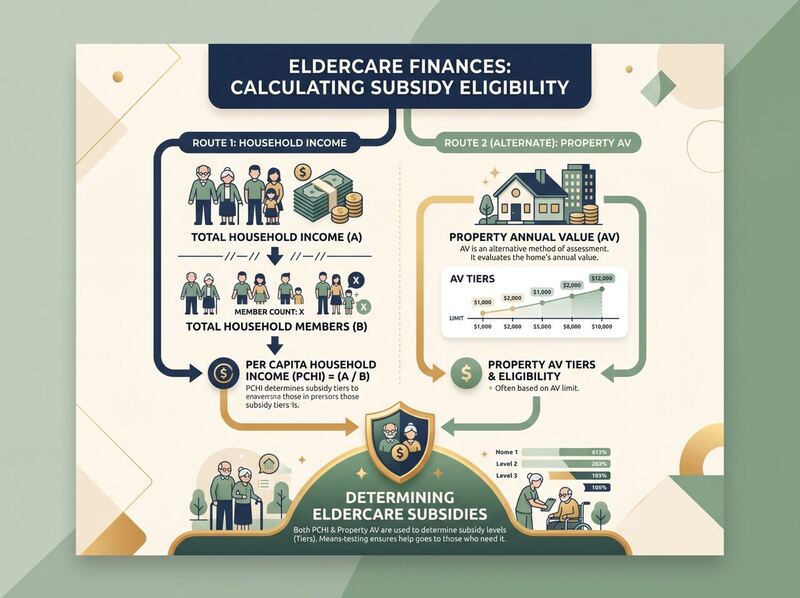
Means-testing is how the relevant agencies determine the level of subsidy a person may receive. Where there is household income, AIC explains that the key measure is monthly household income per person: total gross household monthly income divided by the number of family members living at the same NRIC address. Gross income can include employment income, self-employed or trade income, overtime, allowances, cash awards, commissions and bonuses.
Where there is no household income, Annual Value may be used instead. Annual Value is an estimate of the gross annual rent a property could fetch, excluding furnishings and maintenance fees. In 2026, the relevant subsidy assessment uses 2025 Annual Values.
For households with no income, the residential subsidy applies only if the home’s Annual Value is S$21,000 or below. Above S$21,000, the subsidy is 0%. Families whose parent lives in private property should check the property’s Annual Value with IRAS before assuming any subsidy.
The household definition can be emotionally sensitive, particularly when adult children do not live with the parent or when family support is complicated. Rather than trying to infer the answer, ask the hospital medical social worker, AIC Link or the appropriate official service to explain which information is required in your family’s circumstances.
What families pay after subsidy
The table below shows what the monthly bill could look like for a Singapore Citizen at different household incomes. Each example starts from AIC’s basic cost of S$3,900 a month, applies the MOH subsidy rate effective 1 July 2026, then takes off CareShield Life and MediSave Care where they may apply.
| Your parent | Monthly PCHI | Subsidy | After subsidy | After CareShield Life (S$689) | After MediSave Care (S$200) |
|---|---|---|---|---|---|
| Born in or before 1969 | S$800 | 80% | S$780 | Not applied | S$580 |
| Born in or before 1969 | S$2,000 | 65% | S$1,365 | Not applied | S$1,165 |
| Born in or before 1969 | S$3,000 | 35% | S$2,535 | Not applied | S$2,335 |
| Born in or before 1969 | S$4,000 | 15% | S$3,315 | Not applied | S$3,115 |
| Born after 1969 | S$2,000 | 60% | S$1,560 | S$871 | S$671 |
| Born after 1969 | S$4,000 | 10% | S$3,510 | S$2,821 | S$2,621 |
Illustrations only. Based on a S$3,900 basic monthly fee. GST where charged, deposits and extras are not included. The nursing home and the official means test give the real figure.
Three things to note when you read the table:
- CareShield Life is not applied for parents born in or before 1969. Most people in this group are on ElderShield or have no long-term-care insurance, because CareShield Life covers them only if they chose to join. If your parent did join, take off their payout. CPF says the payout for a claim starting in 2026 is S$689 a month, or a fixed S$612 for those born in 1954 or earlier who joined at age 67 or above. ElderShield payouts are lower and depend on the plan.
- CareShield Life and MediSave Care need severe disability. Your parent must meet the assessment criteria before either applies. The S$200 MediSave Care figure also needs a combined balance of S$20,000 or more.
- The subsidy falls quickly as income rises. For a parent born in or before 1969, moving from S$2,000 to S$3,000 PCHI adds about S$1,170 a month to the bill.
For a single worked example with the full band table, see the nursing-home directory. To run your own numbers, use the Care Costs and Funding Planner.
How to check your parent’s subsidy tier
You do not need to work out the band yourself. MOH uses the household information it already holds for MediShield Life means-testing.
- Log in with Singpass to the MediShield Life Household Check e-Service to check or update who is counted in your parent’s household.
- If you cannot use the e-Service, call the MediShield Life hotline on 1800 222 3399, Monday to Friday, 8.30am to 5.30pm.
- If your parent’s household has no income, check the property’s Annual Value on the IRAS website. Assessments in 2026 use 2025 Annual Values.
- Ask the medical social worker or nursing home to confirm the subsidy rate in writing before admission.
Who can apply for subsidised nursing-home care?
For a subsidised nursing-home application, AIC says a loved one needs a referral from a hospital, polyclinic or medical social worker familiar with the person’s condition and care needs. Families can also visit AIC Link for help with the application.
This referral step matters. It is not merely paperwork: it helps establish what care is needed and whether a residential nursing-home setting is the relevant option to explore. A nursing home may be appropriate when a parent needs substantial help with daily living, nursing care or supervision and cannot safely or realistically be cared for at home despite other supports. It is not a diagnosis, a judgment on a family, or an automatic outcome after a hospital admission.
If your parent is in hospital, ask early:
- Who is coordinating discharge planning?
- Has a medical social worker been assigned?
- What care tasks will need to be managed every day after discharge?
- Is temporary support, rehabilitation, home care, a day programme or nursing-home care being discussed?
- What documents and assessments are needed for the next step?
For a practical discharge checklist, read What to Do When a Parent Is Discharged From Hospital and use the Hospital Discharge Planner, and read How to Apply for Subsidised Nursing-Home Care for the referral steps.
Other funding sources to ask about
Government service subsidies are important, but they may not be the only source of support. Whether any of the following applies depends on your parent’s circumstances. Confirm current eligibility directly with the relevant agency or provider.
CareShield Life or ElderShield
CareShield Life provides monthly cash payouts for people who meet the scheme’s severe-disability criteria. The amount depends on the individual’s policy and claim position. For a claim that starts in 2026, CPF says the payout is S$689 a month. Some older adults may have ElderShield or another relevant arrangement instead. A nursing home or AIC may be able to explain the claims process, but families should confirm the policy and payout with the official insurer or CPF/AIC channels.
MediSave Care
MediSave Care may allow eligible Singapore Citizens and Permanent Residents aged 30 and above with severe disability to make monthly cash withdrawals from their own and/or spouse’s MediSave, subject to the scheme’s conditions and balances. The maximum combined withdrawal is S$200 per month, subject to minimum balance criteria starting from S$5,000. With less than S$5,000 in MediSave, no withdrawal is possible. The monthly limit then rises with the balance: S$50 from S$5,000, S$100 from S$10,000, S$150 from S$15,000 and S$200 from S$20,000. A spouse’s MediSave can make up the difference to a combined S$200; children’s MediSave cannot be used. It is a contribution toward long-term-care needs, not a promise that the full nursing-home bill will be covered.
Medical Fee Exemption Card and further assistance
The Medical Fee Exemption Card (MFEC) supports subsidised standard medical treatment for eligible needy residents of certain MOH-funded stay-in care settings, including nursing homes. It has separate residence and means-test requirements. If the family remains unable to afford care after confirmed subsidies and payouts, ask the institution’s medical social worker about available assistance routes rather than delaying the conversation out of embarrassment.
How to compare two nursing homes without being misled by price
It is reasonable to ask about cost. It is not enough to compare cost alone. A lower quoted base price may not include the same services, location convenience, communication practices or ability to meet a parent’s specific needs.
Use the same set of questions for each home:
| Compare | Questions to ask |
|---|---|
| Care scope | Can the home support the daily needs and nursing procedures described by the care team? |
| Fees | What is included, excluded and charged one-off? |
| Location | Can family visit consistently by public transport or car? |
| Communication | Who updates the family, how often and how are concerns escalated? |
| Daily life | What are meals, activities, visiting arrangements and routines like? |
| Dementia or complex needs | Does the home have relevant programmes, experience or a different assessment process? |
| Waiting and admission | What documents are needed and what is the realistic timeline? |
Visit if possible. A brochure and a price list cannot show how a home feels at mealtimes, how staff speak with residents, or whether family members can reasonably stay involved. During a visit, avoid trying to judge a home from one brief interaction. Instead, ask for its routines and observe whether the answers are clear, respectful and consistent.

When home care may be worth exploring first
Residential care is not the only way to respond to rising care needs. Depending on the parent’s wishes, care requirements, home environment and caregiver capacity, some families may explore home nursing, home personal care, centre-based care, rehabilitation, respite or caregiver support first. These options also have costs, limits and subsidy rules.
The question is not whether keeping a parent at home is morally better. The question is whether the arrangement can meet their needs safely and sustainably. A parent who wants to remain at home may need practical support with bathing, transfers, meals, medication routines, nursing procedures or supervision. A family that wants to care at home may still need relief, training and a realistic plan for nights, workdays and emergencies.
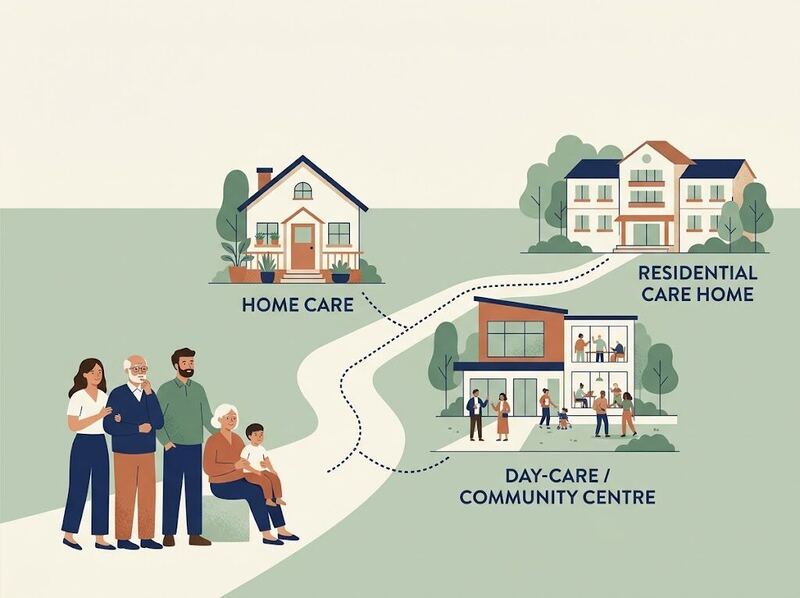
Read Home Care vs Nursing Home for a setting-by-setting comparison, or use the Care Decision Navigator to organise the questions your family needs answered.
A family checklist before accepting a place
Before you agree to admission, aim to have these items in one folder or shared note:
- The written fee quotation and a list of what it includes
- The care category or assessed care needs used for the quotation
- Confirmation of the referral or application status
- Means-test status or the correct next contact to check it
- Confirmation of any CareShield Life, ElderShield or MediSave Care arrangements
- The home’s admission checklist and required medical documents
- Named family contacts and a simple plan for visits and updates
- A list of unresolved questions, including deposits, refunds and what happens if needs change
Do not hand over original documents, personal data or money until you understand who is receiving it, why it is needed and what is documented. If a form or commitment is unclear, pause and ask for an explanation in plain English.
Frequently asked questions
How much does a nursing home cost in Singapore?
AIC states that nursing-home basic cost starts from S$3,900 a month before government subsidies. The actual fee differs by care needs and provider, and there may be deposits or additional charges. Request an itemised quotation.
Can Singaporeans get a subsidy for nursing-home care?
Eligible Singapore Citizens and Permanent Residents may receive means-tested subsidies for MOH-funded nursing-home care. The applicable rate depends on factors including means-test outcome and residency status. A referral is needed for subsidised nursing-home applications.
Does CareShield Life pay for nursing-home fees?
CareShield Life provides monthly cash payouts for eligible people with severe disability. It may help meet long-term-care costs, but it does not make every nursing-home bill free. Confirm the individual’s claim and payout directly.
Can I use MediSave for nursing-home costs?
MediSave Care may provide eligible people with severe disability a cash withdrawal of up to S$200 per month, subject to minimum balance criteria starting from S$5,000 and the scheme’s other conditions. It is not a general withdrawal facility for all nursing-home residents.
Who helps with a subsidised nursing-home application?
Ask a hospital or polyclinic medical social worker, a referral source familiar with the person’s needs, or AIC Link. They can explain the application pathway and the information required.
Sources
ElderSG uses government and statutory sources first. Fees, admission criteria, vacancies and individual eligibility can change; confirm them with the provider and official agency before deciding.
- AIC: Nursing Home
- MOH: Subsidies for Residential Long-Term Care Services
- CPF Board: MediSave Care for long-term care needs
- MOH: Keeping Healthcare Affordable and Sustainable for All
- CPF Board: CareShield Life monthly payout amount
- MOH: MediShield Life Household Check e-Service
- MOF: Budget 2025 Annex F-3, enhanced long-term-care subsidies
- AIC: Medical Fee Exemption Card