Short answer
Respite care is planned, short-term support that lets a caregiver rest, work, recover, travel or deal with an unexpected gap while their parent is cared for safely. In Singapore, options can include support at home, day or centre-based respite, and short stay-in nursing-home respite. The right choice depends on your parent’s needs, the duration required and what support is safe between sessions.
If you are timing respite around a job, check your statutory leave entitlements in Singapore (WorkRightSG, a sister site by ElderSG’s founder).
Care note: Respite is not an emergency service. If your parent is in immediate danger or has a life-threatening medical problem, call 995. If a caregiver is at breaking point, tell the hospital, polyclinic, GP, medical social worker or AIC early rather than waiting for a crisis.
Taking a break is part of responsible care
Many adult children feel guilty even searching for respite. They tell themselves the situation is temporary, that no one else will understand their parent, or that a good son or daughter should cope. In reality, sustained caregiving without sleep, backup or a break can make the home less safe for everyone.
MOH identifies respite care as one of the forms of support available to caregivers. MOH: Caregiving A planned break is not abandonment. It is a practical part of a care plan, especially when a caregiver has their own health needs, employment commitments, a domestic helper’s leave, family travel or simply needs time to recover.
What respite care can look like
| Option | Where care happens | May help when | Key limitation to check |
|---|---|---|---|
| Home-based support | Parent stays at home | Familiar environment is safest and the caregiver needs cover for defined periods | Confirm exact tasks, hours and what happens outside visits |
| Centre-based respite / day care | Senior care centre or day-care setting | Caregiver needs several daytime hours; parent benefits from activity and supervision | Transport, operating days and suitability for care needs |
| Nursing-home respite | Short stay in a nursing home | Parent needs more intensive daily care or the caregiver needs multiple days of cover | Availability, admission requirements and whether the home can meet specific needs |
| Combined plan | Mix of family, home, centre and short stay | No one service covers the whole gap | Someone must own coordination and backup |
MOH says respite care can provide short-term support for several days up to a month at some nursing homes, and that centre-based respite may be available in some senior care centres for a few weekend hours. MOH: ILTC Services
AIC’s “Take a Break” information notes that nursing-home respite is a stay-in option for seniors who are physically or mentally disabled because of illness and depend on caregivers for daily care. AIC: Take a Break
Start with the real reason for respite
The right option changes depending on the gap you are trying to cover.
- A caregiver needs an afternoon or a day to work or rest. Centre-based respite or day care may be practical if transport and centre care are suitable.
- The caregiver needs several nights of sleep or must travel. Consider whether home support can cover the relevant hours; if not, explore nursing-home respite early. AIC’s Night Respite programme stopped taking new applications on 1 December 2024, so it is no longer an option for new families. AIC: Night Respite
- A parent is newly discharged or palliative. See What to Do When a Parent Is Discharged From Hospital and Hospice and Palliative Care in Singapore, and ask the care team about suitable home-based pathways and support; do not assume every respite service can manage complex care.
- The main caregiver is unwell or burned out. Say this plainly. Caregiver capacity is relevant to assessment, not a personal failure.
- The person lives with dementia. Read Dementia Care Options in Singapore, then discuss familiar routines, language, wandering risk, triggers, communication and whether the environment will be distressing.
AIC describes home-based respite care as short-term support for caregivers whose loved ones are receiving home palliative care. From 1 April 2026, AIC says families who need home-based respite care can apply for Enhanced Home Personal Care (HPC+) instead. AIC: Home-based Respite Care The exact service scope and fit must still be confirmed with the provider.
Is respite the right answer—or is the whole care plan breaking down?
Respite can stabilise a care arrangement, but it cannot repair an unsafe long-term plan by itself. Pause and ask:
- Who provides care every day, and for how many hours?
- Is there a safe plan overnight?
- Are there repeated falls, missed medicines, unsafe transfers, severe sleep disruption or caregiver illness?
- Is the gap temporary, or does it occur every week?
- What happens if the usual caregiver is unavailable tomorrow?
If respite becomes a recurring emergency, ask for a broader care assessment (see Home Care vs Nursing Home in Singapore). The longer-term solution may include home personal care, day care, home nursing, therapy, a different living arrangement or residential care. AIC and MOH assess both the person’s care needs and the caregiving situation for HPC+, including the caregiver’s availability and need for support or a break. MOH: HPC+ Eligibility and Priority Assessments
Plan early: the five-step respite checklist
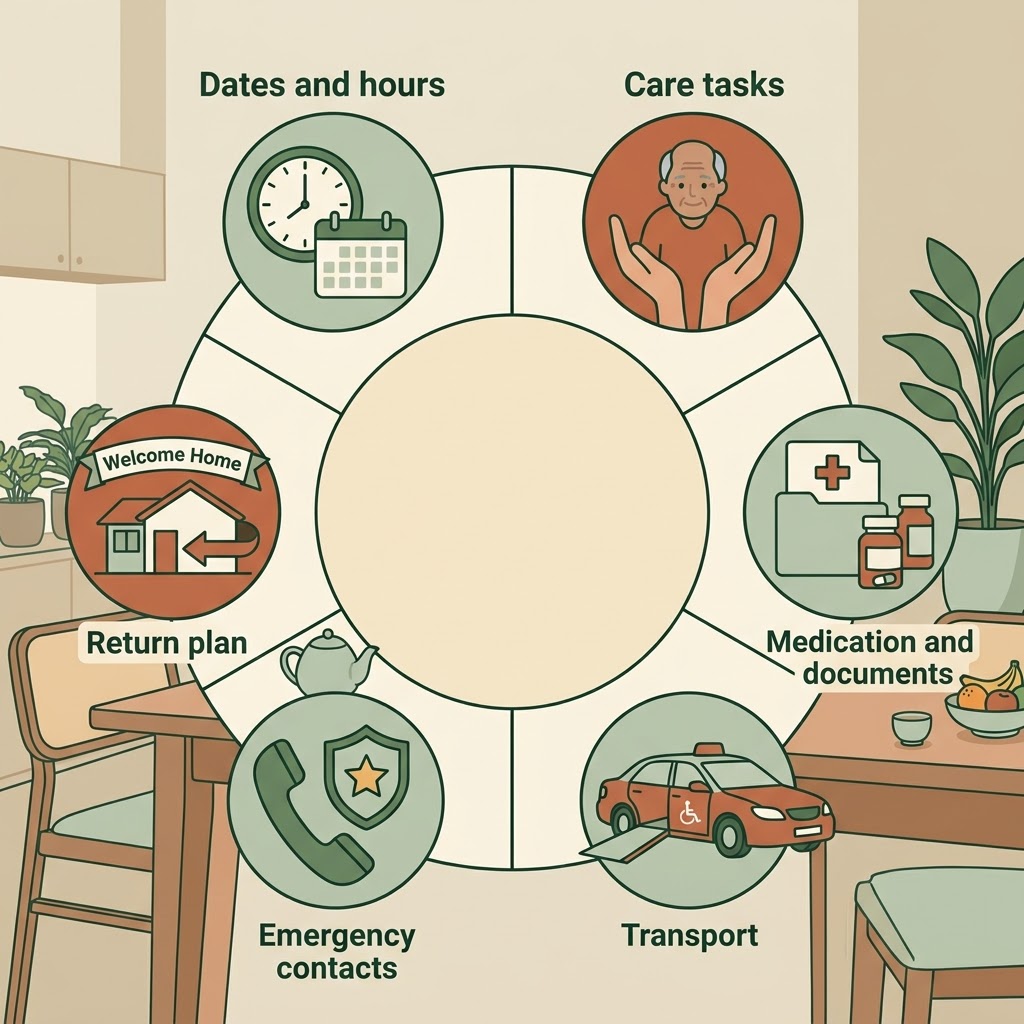
1. Define the gap
Write down exact dates, hours, overnight requirements, transport, personal-care tasks, nursing needs, eating and medication routines. “I need a break” is valid, but a provider needs the practical detail to assess fit.
2. Create a one-page care handover
Include diagnosis/conditions, allergies, mobility and transfer needs, toileting, diet, medication list, clinician contacts, emergency contact, communication preferences, dementia triggers, calming activities and religious/cultural preferences. Keep the original medication and discharge documentation available as required.
3. Ask whether the provider can safely meet those needs
Do not accept a vague “we can manage.” Ask what staff will do for transfers, toileting, falls, distress, refusal to eat, changes in health and medication-related concerns. Ask what the family must supply.
4. Plan the transition
Familiar items, a favourite blanket, glasses, hearing aids, simple routines and a brief life story can reduce distress. Tell the provider what words or approaches help your parent feel safe. Avoid introducing an unfamiliar setting on the same day as a major medical change if an alternative exists.
5. Set a review and return plan
Agree who will pick up or receive your parent, who will answer calls, how updates happen and what would trigger early return or escalation. After the respite period, review whether the caregiver actually recovered and whether the plan should change.
Choosing between home, centre and stay-in respite
Home-based support
This may work best when your parent is most settled in familiar surroundings and the care tasks fit the provider’s scope. It can be useful for defined times, but families must plan coverage before and after visits. Home-based care may not be enough if the caregiver needs several nights away or if the parent needs continuous skilled attention. For what home services cover, read Home Nursing and Home Personal Care in Singapore.
Centre-based respite

This can combine supervision, activities and caregiver relief for a part of the day. AIC says day care supports caregivers who are working or need respite; activities may include meals, personal-care help, basic health support and maintenance exercise. AIC: Day Care Read Senior Care Centres in Singapore for how centres work, then ask about the actual respite session, weekend availability, transport and whether your parent will find the group setting manageable.
Nursing-home respite
This is the option to explore when your parent needs a stay-in arrangement and is dependent on caregivers for daily needs. Begin the conversation early: AIC asks for the referral application to be submitted 4 weeks before the intended start date, with a referral from a hospital, polyclinic or GP and medical documents dated within the last 6 months. Availability should never be assumed: spaces are limited, and each stay is at least 7 days, up to 30 days a year. AIC: Take a Break AIC lists daily room and board from $131 for an open ward, before subsidies and excluding administration fees, consumables and a refundable deposit. Subsidies may apply to Singapore Citizens or PRs, subject to means testing. AIC: Nursing Home Respite Care
If you need respite at short notice
There is no official fast-track for nursing-home respite. AIC asks for the referral 4 weeks before the start date, spaces are limited, and a senior who needs urgent medical attention is not eligible. AIC: Nursing Home Respite Care MOH says AIC works with nursing homes to prioritise clients with urgent care needs, but the wait still depends on bed availability and the family’s needs. MOH: Respite Care Options (10 March 2023)
What you can do now:
- Call AIC on 1800-650-6060. The hotline runs Monday to Friday, 8.30am to 8.30pm, and Saturday, 8.30am to 4pm. It is closed on Sundays and public holidays. AIC: Contact Us
- Tip: if the caregiver is going into hospital, ask the ward’s medical social worker early to help plan cover for your parent and start any referral.
- Bridge the gap with day care. AIC says seniors can attend day care on an ad hoc basis, even for a day. AIC: Take a Break Tip: this can cover working days while a longer plan is arranged.
- Use HPC+ at home. Enhanced Home Personal Care is offered by the hour or in 4-hour blocks when a caregiver needs a break, from $25 an hour before subsidies. A doctor’s assessment is needed first. AIC: Enhanced Home Personal Care
- Tip: prepare before you need it. Keep the one-page care handover up to date and hold a recent medical report. AIC needs one dated within 6 months of admission, so a current report lets a referral move faster.
- Tip: agree a backup now. A family rota or a helper who knows the routine can cover the first few days.
Costs, subsidies and honest expectations
Ask for a written cost estimate that separates care charges, transport, supplies, medical consumables, meals, assessment, deposit and any weekend or public-holiday charges. Ask whether a subsidy is possible, but do not promise your family a result until eligibility and means testing are confirmed.
HealthHub says MOH provides subsidies for Singapore Citizens and Permanent Residents receiving eligible LTC services from MOH-funded providers, with subsidy levels determined through household means testing. HealthHub: ILTC Subsidies
From 1 July 2026, nursing-home respite is subsidised under the residential long-term care framework: up to 80% for Singapore Citizens born in 1969 or earlier, up to 75% for other Citizens and up to 50% for PRs. MOH: Residential LTC Subsidies Day care and home personal care fall under the non-residential framework, at up to 95%, 80% and 55% for the same three groups. MOH: Non-Residential LTC Subsidies These are maximum rates. Your parent’s actual rate depends on household income per person; if the household has no income, the home’s Annual Value is used, and 2026 subsidy levels use 2025 Annual Values.
If money is a concern, speak early to a hospital or polyclinic medical social worker, AIC Link or the service provider. A plan delayed because nobody raised affordability is still a plan delayed.
Questions to ask a respite provider
- Can you meet my parent’s exact mobility, personal-care, dementia and nursing needs?
- What is the minimum and maximum duration or session length?
- What dates, hours and transport are available? What is the cancellation policy?
- What documents, medication and supplies must we bring?
- How will you contact the family after a fall, distress, medical change or hospital transfer?
- What does a typical day and night look like for someone with these needs?
- What are the full costs before and after any confirmed subsidy?
- Can we visit or arrange a trial before a longer respite stay?
Use the ElderSG Respite Finder, Questions-to-Ask Generator and Care Decision Navigator to compare options on the same criteria.
Frequently asked questions
Is respite only for caregivers who are travelling?
No. It may be used for rest, medical appointments, work, recovery, a temporary loss of help or to prevent burnout. A planned break is often more effective than waiting for a crisis.
Will respite solve ongoing caregiver burnout?
It can help, but persistent strain may signal that the long-term plan needs more support. Discuss regular home care, day care, therapy, financial support and a broader assessment rather than relying on one-off crisis cover.
Can someone with dementia use respite?
Often, but fit must be assessed carefully. Tell the provider about communication, routines, triggers, wandering risk, continence and sleep patterns. A familiarisation visit or short trial may help.
How far ahead should I book?
For nursing-home respite, AIC asks for the referral to be submitted 4 weeks before the start date. For other respite, ask as early as practical: availability, assessment and transport all affect timing. Never assume a same-day placement will be possible. If time is short, see If you need respite at short notice.
What to do next
- Define the dates and care gap in writing.
- Prepare the care-handover sheet and medication information.
- Search ElderSG respite listings by setting and region.
- Ask your parent’s healthcare team, AIC Link or provider for referral and subsidy guidance.
- Treat the break as a review point: decide what needs to change before the next gap occurs.
Sources
- Ministry of Health: Caregiving
- Ministry of Health: Intermediate and Long-Term Care Services
- Ministry of Health: Eligibility and priority assessments for Enhanced Home Personal Care
- Agency for Integrated Care: Take a Break
- Agency for Integrated Care: Nursing Home Respite Care
- Agency for Integrated Care: Home-based Respite Care
- Agency for Integrated Care: Day Care
- HealthHub: Intermediate and Long-Term Care Subsidies
- Ministry of Health: Variety of respite care options available for caregivers of frail seniors
- Ministry of Health: Subsidies for residential long-term care services
- Ministry of Health: Subsidy framework for non-residential long-term care services
- Agency for Integrated Care: Enhanced Home Personal Care
- Agency for Integrated Care: Night Respite
- Agency for Integrated Care: Contact Us
Editorial methodology and independence
This guide uses current public information from MOH, AIC and HealthHub, checked on 5 October 2026. It does not guarantee provider availability, determine subsidy eligibility or replace clinical advice. ElderSG is free for families; any future featured profiles or consent-based enquiries will be visibly labelled and will not determine editorial recommendations.