
Short answer
Home nursing brings clinical nursing care into your parent’s home; home personal care helps with everyday tasks such as washing, dressing, toileting, feeding, mobility and housekeeping. Families often need both, but they solve different problems. Start with the exact task, how often it is needed, and what happens between visits.
Safety note: Home services are scheduled support, not a substitute for emergency care or round-the-clock supervision unless a provider has specifically agreed to that arrangement. For life-threatening symptoms, call 995. For new clinical concerns, follow the treating team’s advice.
Why families confuse these services
When a parent comes home after a hospital stay, the phrase “home care” can sound like one complete solution. It is not. A nurse, a trained personal-care worker, a doctor, therapist, transport provider and family caregiver may each have different roles. Assuming that one service covers everything is one of the fastest ways for a household to feel abandoned after the first visit.
MOH describes home-based services as support for frail and home-bound clients who have difficulty accessing services in the community. The services support health and social needs, family caregiving and ageing in place. MOH: Intermediate and Long-Term Care Services
This guide helps adult children work out which conversations to have before choosing a provider. It does not assess a parent’s clinical eligibility or prescribe care. If your parent is about to leave hospital, start with What to Do When a Parent Is Discharged From Hospital.
Home nursing versus home personal care
| Question | Home nursing | Home personal care / Enhanced Home Personal Care (HPC+) |
|---|---|---|
| Main purpose | Nursing care and clinical care-plan support at home | Help with daily and personal-care activities at home |
| Usually delivered by | Nursing professionals | Trained care professionals/carers |
| Examples | Wound dressing, injections, stoma care, nasogastric-tube procedures, caregiver training | Feeding, dressing, toileting, washing, walking, transfers, housekeeping, medication reminders and selected mind-stimulating activities |
| Best starting question | “Does my parent require a nurse for this task?” | “Which daily tasks cannot be safely completed without help?” |
| What it does not automatically mean | Continuous medical monitoring or a doctor at every visit | 24-hour care, nursing procedures, or clinical diagnosis |
MOH states that home nursing includes services such as wound dressing, injections, stoma care and nasogastric-tube insertion at home; nurses also manage and review care plans with doctors and provide caregiver training. MOH: ILTC Services
MOH describes home personal care as help from a trained carer with tasks such as showering, housekeeping, medication reminders, mind-stimulating activities and other personal-care tasks. From 1 April 2026, Enhanced Home Personal Care (HPC+) provides more tailored and frequent support for people with higher care needs, including technology-enabled monitoring; AIC describes this as 24/7 monitoring and response to falls using digital devices installed in the home. MOH: Care Services
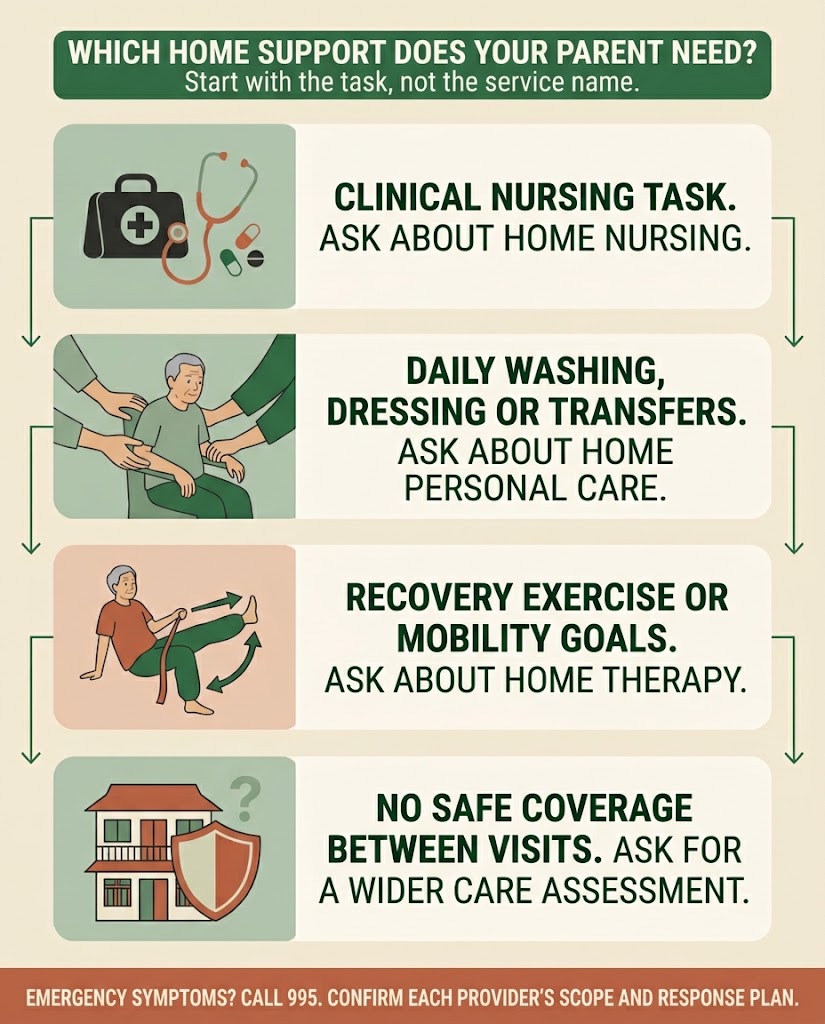
Start with the task, not the provider label
Make a one-week task list before calling providers. Include the time, difficulty and person currently doing it.
- Clinical/nursing tasks: dressing changes, device care, injections, tube-related care, monitoring or a clinician-directed plan.
- Personal tasks: showering, dressing, toileting, grooming, feeding, moving between bed and chair, safe walking.
- Household and routine: simple housekeeping, preparing the environment, meal support, reminders, companionship and activities.
- Recovery tasks: exercises or rehabilitation prescribed by a therapist. These may require home therapy rather than nursing or personal care.
- Medical review: a home medical service may be relevant when a doctor needs to assess someone who cannot leave home. AIC: Home Medical
- Appointment access: consider medical escort and transport if the main issue is getting safely to appointments.
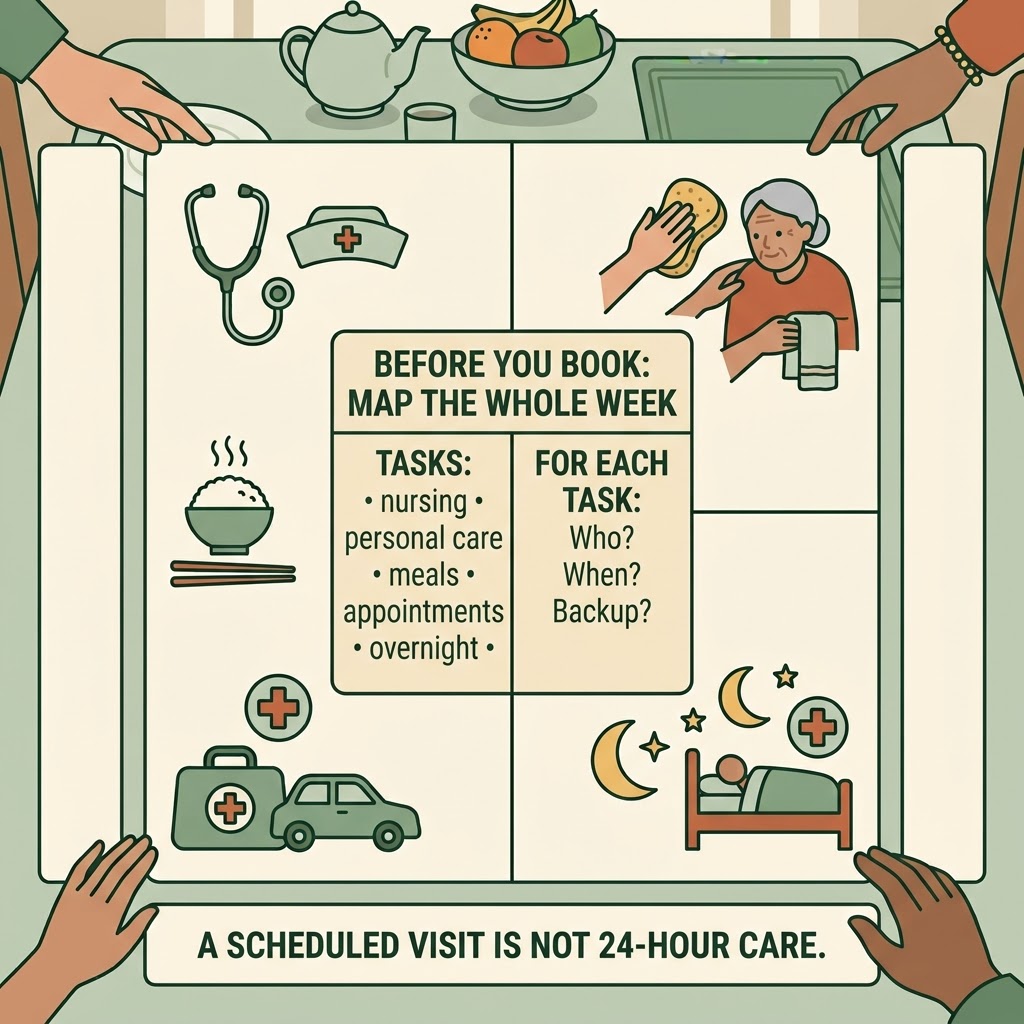
Then mark the gaps. Who covers the morning? Who is responsible overnight? What happens if your parent refuses help, has a fall, becomes confused, or the usual caregiver is sick? A provider can tell you whether it covers a visit; only the family care plan can show whether it covers the week.
When home nursing may fit
Home nursing can be worth discussing when a parent is home-bound and has a nursing-care need that can be safely managed at home according to the clinician’s plan. It is especially relevant when family caregivers need to learn a care routine or need professional oversight of a task that they should not improvise.
Ask the referral team or provider:
- What nursing task is needed, and how frequently?
- Who is responsible between visits?
- Will the nurse train a caregiver, and what must the caregiver demonstrate before taking over?
- What equipment, supplies and home environment are needed?
- Which change in symptoms requires a call to the provider, doctor or emergency services?
- Can the provider coordinate with the treating doctor and share an updated care plan with consent?
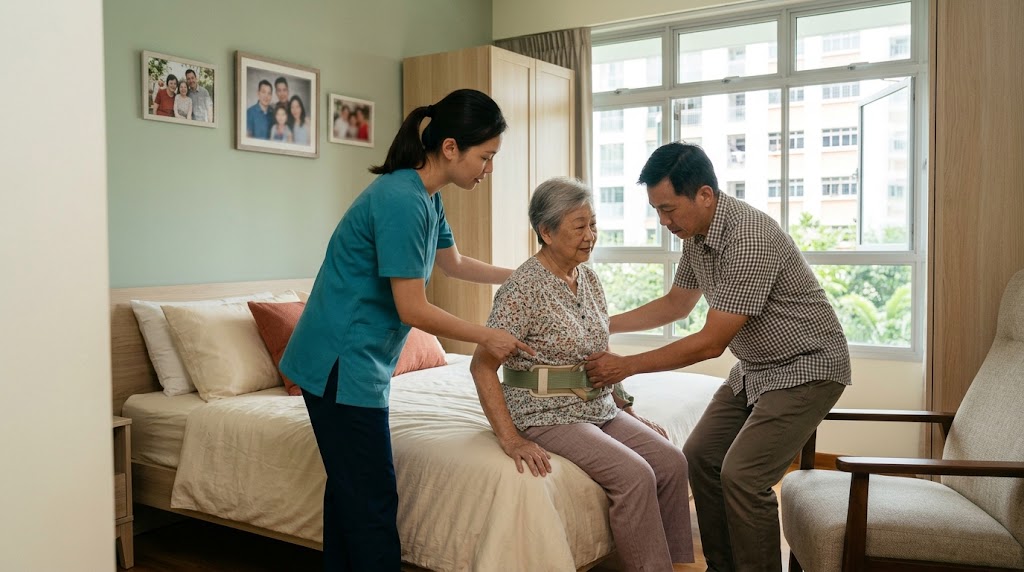
Home nursing is not necessarily the answer to a caregiver who needs more time for bathing, feeding or supervision. It can complement HPC+, but families should not assume the nurse will remain for non-nursing tasks or provide overnight cover.
When Enhanced Home Personal Care may fit
AIC says HPC+ provides help with daily or personal-care activities at home. It is aimed at seniors and clients who cannot do these tasks themselves, have no caregiver or whose caregiver needs support or a break. AIC: Enhanced Home Personal Care
It may suit a family when the parent wants to remain at home and needs reliable help with ADLs or instrumental tasks, but the household can still cover the hours outside service visits. It can be useful after discharge, for progressive frailty, when a family caregiver returns to work, or when caregiving needs are becoming too physically demanding.
It is not a promise that every provider can cover every hour, every task or every home layout. Ask about visit length, frequency, continuity of carers, weekend/after-hours support, what happens when a worker is delayed, and whether the provider can support dementia-related needs (see Dementia Care Options in Singapore). MOH notes that some home personal-care providers are able to look after clients, including those with dementia, when usual caregiving arrangements are unavailable; this must be verified with the individual provider. MOH: ILTC Services
The decision path families can use
- Is the task clinical? Start with the doctor, discharge team or home-nursing discussion.
- Is the task daily living? Explore HPC+ or another appropriate personal-care service.
- Is the task rehabilitation? Ask about home therapy or community rehabilitation.
- Is the issue the caregiver’s availability? Map coverage and consider respite, day care (see Senior Care Centres in Singapore) or a combination.
- Is home still safe between visits? If not, ask for a broader care assessment rather than adding isolated services one at a time.
The care setting should change when reality changes. Repeated falls, unsafe transfers, caregiver exhaustion, distressing nighttime behaviour, missed essential care or a home that cannot be made safe are reasons to seek professional reassessment.
Applying, fees and financial support
For subsidised services, speak to your parent’s doctor at a hospital or polyclinic, a medical social worker, or AIC/AIC Link. AIC’s service pages state that Singapore Citizens or Permanent Residents may qualify for subsidies subject to the relevant conditions and assessment; 2026 subsidy levels use 2025 Annual Values. Confirm the current outcome for your family rather than relying on a friend’s experience. AIC: Home Nursing
MOH’s non-residential long-term-care subsidy framework covers services including home medical, home nursing, home therapy and home personal care. From 1 July 2026, eligible Singapore Citizens born after 1969 can receive up to 80% subsidy, citizens born in 1969 or earlier up to 95%, and Permanent Residents up to 55%, depending on household means testing. MOH: Non-Residential LTC Subsidies
As a guide, AIC lists home nursing from S$62 per visit and HPC+ from S$25 per hour, both before subsidies. Ask for an itemised quote before agreeing. Clarify assessment fees, visit duration, transport, consumables, weekend charges, cancellation fees, equipment and services outside the subsidised scope. Do not present a service’s “from” price as the expected monthly cost.
Questions to ask providers
For home nursing
- Which nursing procedures can you provide in this home?
- Who will carry out the visit and how is care continuity managed?
- What training can you provide to family caregivers?
- What information will be shared with the parent’s doctor, with consent?
- What is the escalation protocol for a clinical concern between visits?
For home personal care
- Which personal tasks are included and excluded in each visit?
- Can the carer safely assist with transfers, bathing and toileting for this parent?
- How often can visits occur and how long will they be?
- Can the provider support dementia, communication or behavioural needs where relevant?
- How will the family receive updates, and what happens if a visit cannot proceed?
For every provider
- What are the all-in costs before and after any confirmed subsidy?
- Do you cover our neighbourhood and preferred hours?
- Is there a care assessment before service begins?
- Who is the named contact for a concern, and what is the after-hours arrangement?
Frequently asked questions
Can home nursing replace a doctor?
No. Home nursing delivers nursing care according to the care plan and coordinates with doctors where appropriate. If a doctor needs to assess a home-bound patient, ask whether home medical care is suitable.
Can a carer administer medication?
Do not assume. Ask the provider exactly what medication support it offers and what must be performed by a nurse or family caregiver. Follow the treating clinician’s plan.
Does HPC+ mean 24-hour monitoring?
Not 24-hour care. AIC says HPC+ can include 24/7 monitoring and response to falls through digital devices installed at home, but carers visit on a schedule. Confirm the service scope, visit frequency and response arrangements with the provider, and still plan for non-visit hours and emergencies.
When should we consider a nursing home instead?
Consider broader residential assessment when the parent needs extensive daily assistance or nursing support that cannot be safely covered at home despite realistic services and caregiver support. This is a care-planning decision, not a failure by the family. Read Home Care vs Nursing Home in Singapore and Nursing Home Costs in Singapore.
What to do next
- Complete a one-week care-task map.
- Speak to the discharge team, GP, polyclinic or medical social worker about the correct referral.
- Compare home care listings by region, service type and care need.
- Use the Care Decision Navigator and Questions-to-Ask Generator before agreeing to a provider.
- Reassess after the first two weeks: safety, caregiver sleep, task coverage and the parent’s experience are the core measures.
Sources
- Ministry of Health: Intermediate and Long-Term Care Services
- Ministry of Health: Care Services
- Ministry of Health: Subsidy framework for non-residential long-term care services
- Agency for Integrated Care: Home Nursing
- Agency for Integrated Care: Enhanced Home Personal Care (HPC+)
- Agency for Integrated Care: Home Medical
Editorial methodology and independence
This guide uses current public information from MOH and AIC, checked on 5 October 2026. It does not provide clinical instructions, determine service eligibility or guarantee provider availability. ElderSG is free for families; any future featured profile or consent-based enquiry arrangement will be clearly labelled and will not determine editorial recommendations.