
Short answer
Home care may be worth exploring when your parent can remain at home safely with reliable support, a suitable home environment and a sustainable caregiver plan. A nursing home may be appropriate to explore when daily care, nursing needs or supervision cannot realistically be met at home, even after home and community services have been considered. Neither choice is automatically better. The practical question is whether the arrangement meets your parent’s needs, wishes and dignity without putting the family in an unsafe or impossible position.
Adult children often arrive at this decision after a fall, a dementia diagnosis, a hospital stay or months of increasing caregiver strain. It can feel as though there are only two choices: “keep Mum at home” or “send Dad to a home”. In practice, Singapore families can consider a range of supports between those two points, including home nursing, home personal care, centre-based care, respite care and rehabilitation. This guide helps you compare the main settings without diagnosing a parent, deciding subsidy eligibility or recommending a particular provider.

Start with your family’s situation in the Care Decision Navigator. Compare source-checked services in the ElderSG provider directory.
What does home care mean in Singapore?
“Home care” is an umbrella term. It does not mean one service, one price or one level of support. AIC lists services such as home nursing, home medical care and home personal care for people who are homebound or need support with care at home. The exact scope, referral route, charges and subsidy eligibility vary by service and provider.
Home nursing may be relevant where a person needs clinical support such as wound care, tubes or nursing monitoring. Home personal care may help with daily activities such as bathing, grooming, toileting, feeding or transfers. Home medical care may be relevant for a frail or homebound person who needs medical management at home. A family may use one service, several services, a domestic helper, informal family caregiving or a combination.
The benefit of home care is not merely familiarity. It can allow a parent to stay in a known environment, keep familiar routines and remain near family, neighbours and community life. However, home care is only a good plan if someone can coordinate it, the home is reasonably safe and support exists for the gaps between paid visits. A nurse’s one-hour visit does not provide 24-hour supervision.
What does nursing-home care mean?
A nursing home is residential long-term care. The person moves into the home and receives daily living support, nursing care and activities there. AIC describes nursing homes as an option for people who cannot move around or manage daily activities without help or supervision, and who cannot be cared for at home even after other options have been tried.
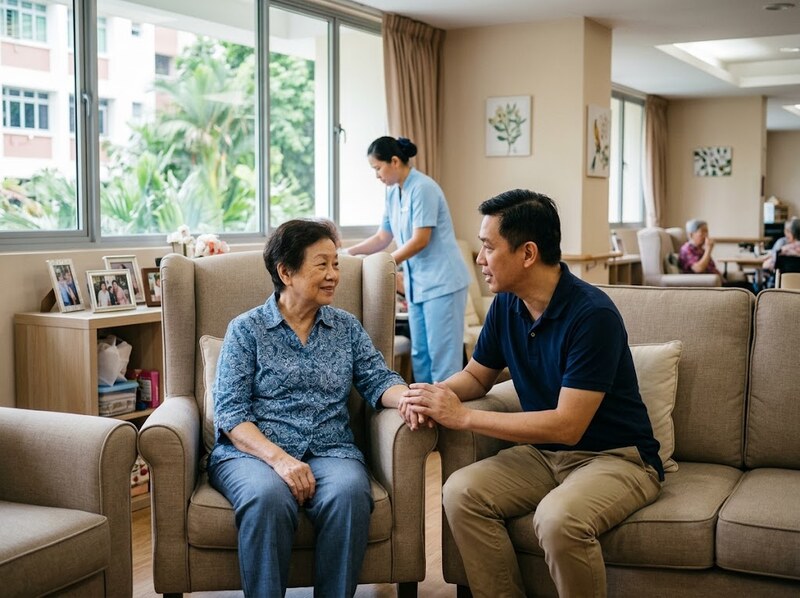
Residential care can offer more continuous support than a family can arrange at home. It can be worth exploring when care is needed throughout the day and night, when a person has complex nursing needs, when supervision is essential or when caregiver exhaustion has become serious. It also changes family life: visits replace co-residence, the resident adapts to a shared environment and the family needs to communicate with the care team.
Choosing a nursing home is not proof that a family has failed. Choosing home care is not proof that the family can manage alone. Both decisions can be thoughtful, caring and difficult.
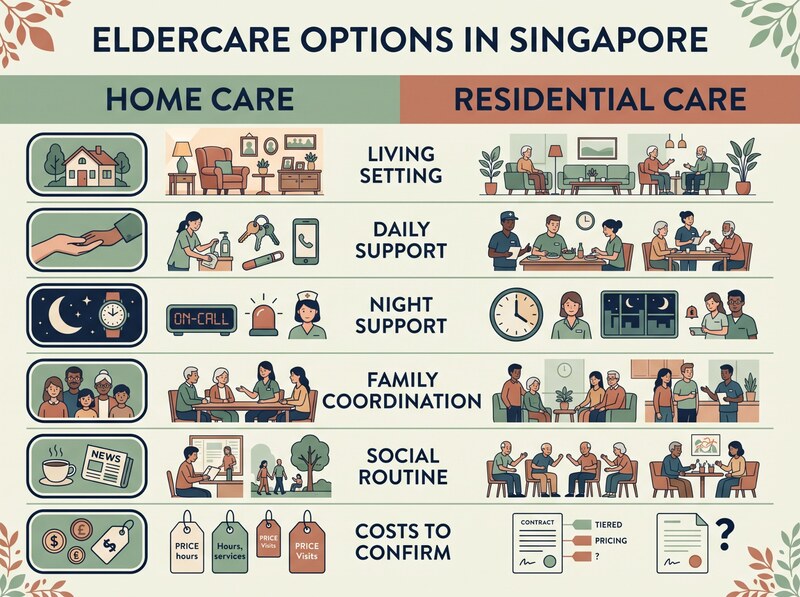
Home care vs nursing home: a practical comparison
| Question | Home care | Nursing home |
|---|---|---|
| Where does your parent live? | At home, with family and/or paid support visits | In a residential care setting |
| Daily support | Depends on family, helpers and booked services | Daily support is organised within the home |
| Overnight supervision | Must be arranged separately | Available within the residential setting, subject to the home’s care model |
| Familiarity | Familiar home, routines and neighbourhood | New environment and shared routines |
| Family role | Often coordinates schedules, medication, appointments and emergencies | Continues advocacy, visits and communication with staff |
| Home environment | May require adaptations and safe transfer arrangements | Designed around residential care, but visit to assess fit |
| Cost discussion | Service fees, transport, consumables, helper costs and adaptations may all matter | Monthly fee, subsidy, deposits and stated additional charges may matter |
| Best next question | Can this plan cover every day and every night safely? | Can this home meet the parent’s needs and keep family involved? |
This table does not produce a score. A parent may be physically frail but emotionally settled at home with adequate help. Another may have relatively stable medical needs but be unsafe alone because of wandering, night-time confusion or repeated falls. The relevant facts are practical, personal and change over time.
Start with the care tasks, not the label
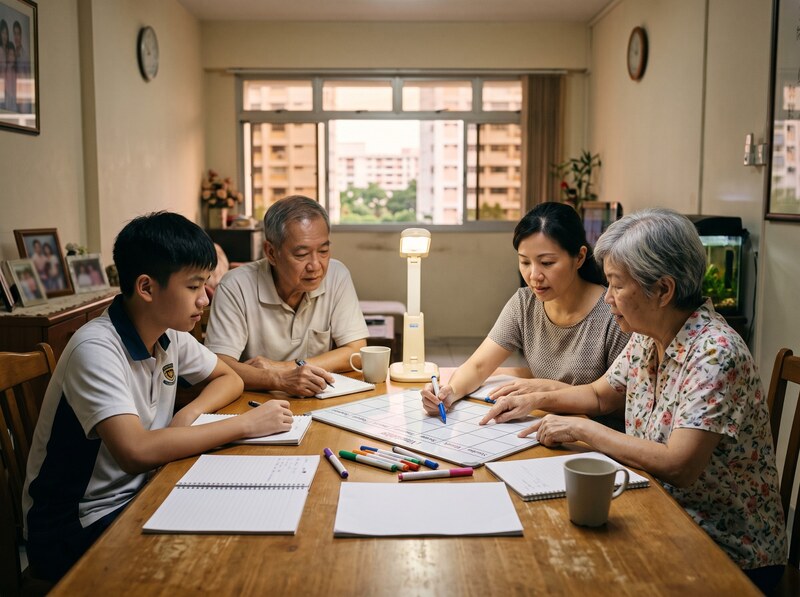
Before comparing providers, list what actually happens in a typical day. Include bathing, dressing, meals, toileting, transfers, mobility, medication prompts, appointments, wound care, memory support, overnight waking and companionship. Then ask who does each task now, who could do it safely, and what happens if that person is ill, at work or overwhelmed.
This exercise often makes the decision clearer. Some families discover that a few targeted services, a safer bathroom and a regular respite arrangement could make home care more sustainable. Others discover that the plan relies on one exhausted child doing physical transfers twice every night. That is not a sustainable care model, however loving the intention is.
When home care may be a realistic option
Home care may be worth exploring where these conditions broadly exist:
- Your parent wants to remain at home and can be supported there safely.
- The home can be adapted or already supports safe mobility, bathing and transfers.
- There is a realistic schedule for care, including evenings, weekends and emergencies.
- The required nursing or personal-care services are available when needed.
- The main caregiver has relief, training and a back-up plan.
- The family can coordinate appointments, supplies, medication and communication.
There are risks to acknowledge. A parent may be alone for long periods between visits. A caregiver may underestimate the physical and emotional work involved. A domestic helper, while often important, should not be assumed to replace clinical care or a coordinated plan. Discuss specific tasks with the hospital team, doctor, therapist or provider rather than assuming that a service can perform every task.
When nursing-home care may be worth exploring
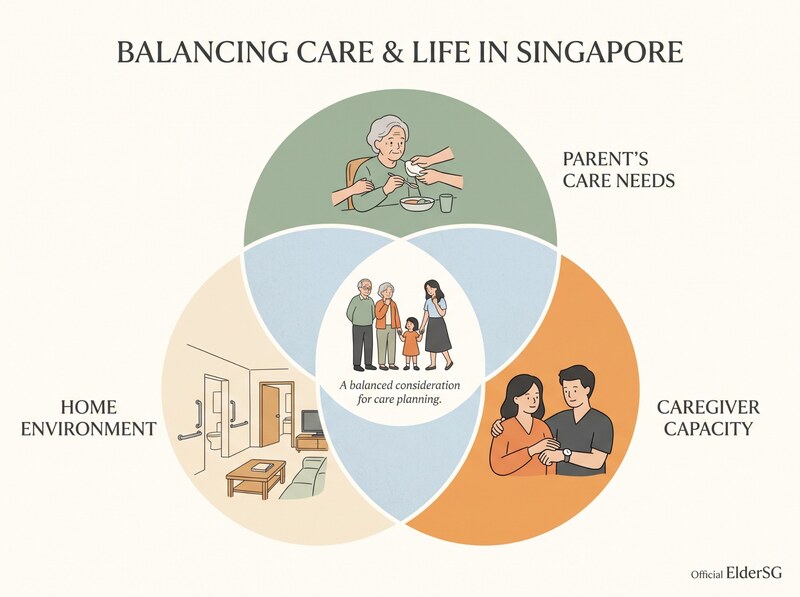
Nursing-home care may be appropriate to explore where a parent requires substantial assistance with daily living, consistent supervision or nursing support that cannot safely be managed at home. It may also be relevant when caregiver capacity has changed: for example, the sole caregiver has their own health condition, works overnight shifts or can no longer perform transfers safely.
Explore residential care early when a hospital discharge is approaching. Waiting until the day before discharge can create pressure and make every option feel worse. Ask the ward team or medical social worker what care needs must be met after discharge and whether a referral is appropriate. AIC says subsidised nursing-home applications require a referral from a hospital, polyclinic or medical social worker familiar with the person’s condition and needs.
Use the Nursing Home Costs in Singapore guide to prepare fee and subsidy questions. AIC states that basic nursing-home cost starts from S$3,900 monthly before government subsidies; individual fees and support must be confirmed directly.
Safety, dignity and caregiver capacity
Families sometimes focus only on their parent’s physical safety. That matters, but dignity and caregiver capacity matter too. Is the parent spending most days alone? Can they reach a toilet safely? Are they frightened at night? Does the caregiver have time to sleep, work, see their own doctor and remain patient? Is conflict increasing at home?
These questions are not a test of filial piety. They are early-warning questions. A care arrangement can be loving and still need more support. If a parent has dementia or has begun wandering, becoming disoriented or resisting essential care, the family may need advice from the treating team and dementia-specific services. Read Dementia Care Options in Singapore, or browse dementia care providers.
Compare costs without comparing the wrong things
The right comparison is total, recurring cost against the care that is actually needed. For home care, note provider fees, transport, consumables, home modifications, caregiver leave, helper costs and respite. For residential care, note the assessed monthly fee, government subsidy, insurance payouts, deposits and stated additional costs. Do not assume that home care is always cheaper or that a nursing-home fee is the whole cost.
Eligible Singapore Citizens and Permanent Residents may receive means-tested subsidies for MOH-funded long-term-care services. From 2026, subsidy frameworks and thresholds changed, so use current official sources rather than old family estimates. Use the Care Costs and Funding Planner to organise questions, not to calculate eligibility.
A five-step family decision process
- Describe needs clearly. Write the daily and night-time tasks, not just a diagnosis.
- Ask what is required for safe discharge or daily care. Get practical training and written instructions where appropriate.
- Test the home-care plan honestly. Include workdays, sleep, back-up caregivers and emergencies.
- Explore alternatives in parallel. Ask about home services, centre-based care, respite and nursing-home referral rather than making an all-or-nothing decision too early.
- Review again after a change. Care needs and caregiver capacity change; a decision can be revisited.
Questions to ask providers
For home-care providers: What tasks can you support? How are visits scheduled? What happens if the usual worker is unavailable? Is transport or after-hours support available? What should family members continue to do?
For nursing homes: What care category is being quoted? What is included in the fee? How are changes in needs handled? How are family updates managed? What are visiting arrangements and escalation procedures? Can you explain the admission and referral process?
Use the Questions to Ask Generator to turn these into a printable visit list.
Frequently asked questions
Is home care better than a nursing home?
Not automatically. Home care may suit a parent who can remain safe with adequate support. A nursing home may be more suitable to explore when care and supervision cannot realistically be delivered at home. The parent’s wishes, safety, care needs and caregiver capacity all matter.
Can my parent receive nursing care at home?
Home nursing is available for eligible homebound people who need nursing support. Ask the doctor, hospital team, AIC or provider about the relevant service scope, referral and current subsidy information.
When should I consider a nursing home?
Consider discussing residential care when daily care, supervision or nursing needs cannot be managed safely at home, even with support services, or when caregiver strain has become unsustainable.
Are subsidies available for both settings?
Eligible Singapore Citizens and Permanent Residents may receive means-tested subsidies for MOH-funded long-term-care services in residential and home/community settings. Confirm current eligibility through the appropriate official channel.
What if our family disagrees?
Return to the parent’s needs and wishes where possible, and ask the treating team or medical social worker to explain the practical care requirements. A family meeting with a written list of concerns can be more useful than debating labels.
Sources
Confirm individual service availability, costs and eligibility with AIC, the provider and the relevant care team.