
Short answer
To apply for subsidised nursing-home care in Singapore, your parent normally needs a referral from a hospital, polyclinic or medical social worker who understands their condition and care needs. AIC then coordinates the service application and means-testing process. Eligibility is not based on age alone, and a family should not wait until discharge day to raise the subject. Start by asking the treating team or polyclinic doctor for a care-planning discussion, explain what cannot safely be managed at home, and prepare a clear picture of your parent’s daily and night-time needs.
This guide explains the usual pathway. It cannot confirm that a person will qualify, calculate a subsidy, choose a home for your family or guarantee a vacancy.
What does “subsidised nursing-home care” mean?
A nursing home is a residential long-term-care setting for people who need help with daily living, nursing care or supervision and cannot be safely cared for at home after other realistic arrangements have been explored. In a subsidised placement, the provider is part of the MOH-funded long-term-care system and the care recipient’s assessed subsidy reduces the payable fee. It is not a free placement, and the amount a family eventually pays depends on the person’s assessed care needs, the provider’s charges, subsidy outcome and other applicable financing support.
The important distinction is between the care decision and the funding assessment. A family may feel that residential care is necessary because a parent needs frequent transfers, cannot be left alone, has advanced dementia, requires complex nursing support or has no sustainable caregiver arrangement. The referral team assesses whether the clinical and social circumstances meet the service’s requirements. Means-testing then assesses the government subsidy level. Treat these as related but separate conversations.
Private nursing-home placement is different. A family can approach a private provider directly, but should still ask detailed questions about care scope, fees, admission criteria and whether the person’s needs can be met. If you are exploring a subsidised placement, start through the referral pathway rather than assuming that a direct enquiry alone is an application.
Who may be considered for a subsidised nursing-home placement?
According to AIC’s current guidance, a person applying for subsidised nursing-home placement should generally meet all of these broad conditions:
- Have physical or mental disabilities arising from medical conditions such as stroke, dementia or chronic illness.
- Be semi-mobile, wheelchair-bound or bed-bound, and need daily nursing care and help with activities of daily living such as toileting or walking.
- Have tried possible care arrangements, which may include home care, day care or a domestic helper where appropriate.
- Be unable to be cared for safely at home by family members or community providers.
- Be a Singapore Citizen or Permanent Resident.
These points are not a family self-assessment form. They explain why the referral conversation needs specifics. “Mum is getting weaker” is an important concern, but it helps to describe what that means: whether she needs two people to transfer her, wakes repeatedly overnight, falls, wanders, cannot toilet independently, misses medication, needs wound care, or has no person available to provide essential supervision.
Do not assume that a diagnosis by itself makes someone eligible. A person with dementia, for example, may have very different support needs depending on mobility, behaviour, safety risks, ability to manage daily tasks and the family’s caregiving capacity. Conversely, a parent may not be bedridden but still have needs that cannot safely be met at home. The healthcare and social-work team needs the actual situation, not a label.
Step 1: Start the discussion early
If your parent is in hospital, tell the ward team as soon as you believe home may not be safe or sustainable after discharge. Ask to speak to the doctor, nurse, therapist or medical social worker. Do not treat this as a request to “send” your parent somewhere. Explain the practical care gaps: who is available at home, which tasks they can and cannot safely do, what support has already been tried, and what happens at night or when the main caregiver is working.
If your parent is at home, a polyclinic can be an appropriate starting point. AIC states that a referral for subsidised nursing-home placement is required from a hospital, polyclinic or medical social worker familiar with the person’s condition and care needs. An AIC Link can also help families understand the wider long-term-care process and where to seek assistance.
Bring the parent into the conversation where possible and appropriate. Residential care affects their daily life, relationships, routines and sense of control. If your parent has decision-making capacity, explain the discussion in plain language, ask what matters to them and record concerns they want raised. If communication is difficult, family members can still describe known preferences, language needs, spiritual or dietary considerations, and what helps the person feel settled.
Step 2: Prepare a factual care picture
The referral team will need information that paints a truthful picture of daily life. Families often minimise the situation because they feel guilty, or overstate it because they are distressed. Neither helps. Make a seven-day note before the appointment if you can. It does not need to be polished.
Record:
- Mobility: walking, wheelchair use, transfers, falls and whether one or two people are needed.
- Personal care: bathing, dressing, toileting, feeding, continence and grooming.
- Nursing and health needs: wound care, tubes, medication support, monitoring, therapy or follow-up appointments.
- Cognition and safety: confusion, wandering, leaving the stove on, unsafe behaviour, agitation, night-time waking or inability to call for help.
- Current support: which relatives, helpers, neighbours, day-care services, home-care providers and healthcare professionals are involved.
- Caregiver capacity: work schedules, health limitations, sleep disruption, physical ability to transfer the parent and any absence of back-up.
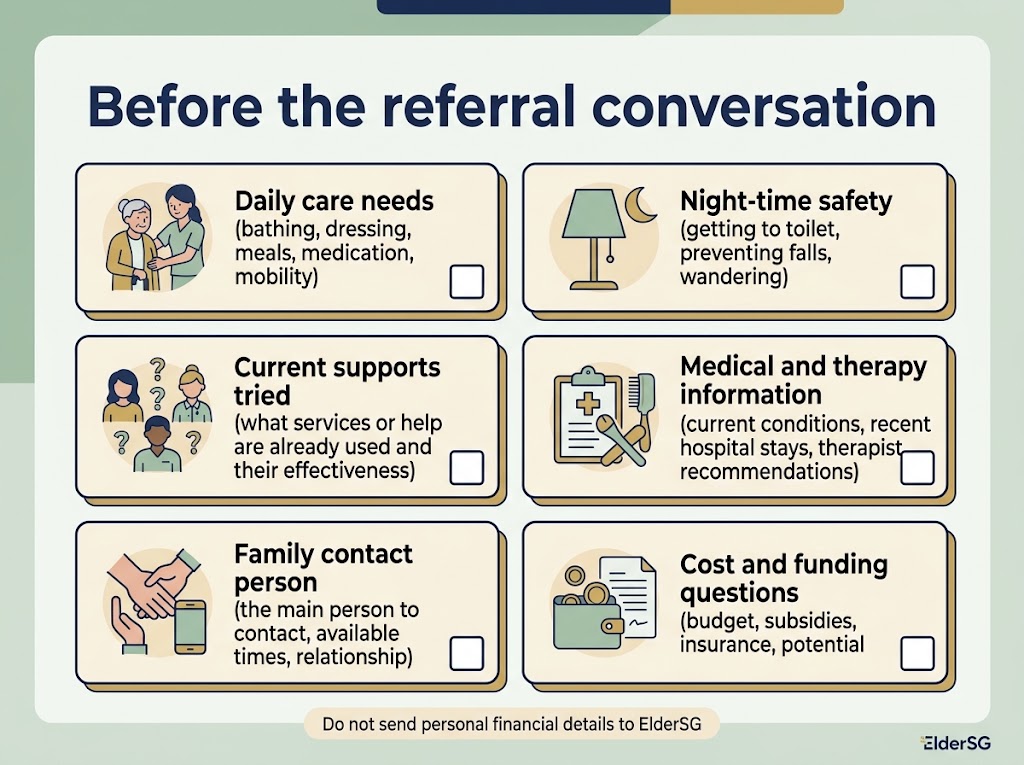
This is not evidence that you are a bad son or daughter. It is how the team identifies what care is actually required. A home arrangement may be loving and still no longer be safe. Conversely, the notes may show that targeted home and community supports could make it possible for a parent to remain at home. A well-run assessment should explore options, rather than make a family defend a decision they have already made under pressure.
Step 3: The referral and application process
The referring professional prepares the nursing-home referral. AIC’s referral guidance explains that the application is made by a hospital, polyclinic or medical social worker who knows the person’s condition and needs. The referral includes relevant clinical, functional and social information so that the appropriate level of care can be considered.
Families can make the process smoother by having one main contact person. That person should keep a list of questions, return calls promptly, make sure family members are using the same facts, and ask how updates will be communicated. If different siblings have different views, a short written summary of the parent’s needs and family constraints is more productive than a disagreement at the referral meeting.
Consent and declarations may be part of the residential-service application. Read documents before signing. Ask what information will be shared, with which agencies or providers, and how you can correct an error. Do not send NRIC numbers, bank information, passwords or financial documents to ElderSG, unverified WhatsApp contacts or an unofficial online form. Use the channels directed by AIC, the hospital, polyclinic or recognised provider.
Use the ElderSG Subsidy & Application Checklist to organise your questions. It is a preparation tool only: it does not calculate eligibility and it does not store your personal data.
Step 4: Understand means-testing without guessing the result
MOH subsidies for residential long-term-care services are means-tested. In plain language, this means the subsidy level depends on the assessed financial circumstances under the prevailing government framework, not merely on the nursing home selected. HealthHub states that MOH provides subsidies for Singapore Citizens and Permanent Residents receiving long-term-care services from MOH-funded providers.
The criteria and subsidy tables can change. In 2026, official material notes that subsidy determinations use the relevant income and/or Annual Value framework, and there were significant long-term-care financing enhancements from July 2026. That is why an old example from a relative, Facebook post or three-year-old article should not be treated as an estimate for your family.
Ask the referral team these direct questions:
- Which financial assessment applies to this service and where can we check the current rules?
- Which documents are required, who receives them and by when?
- What fee is being quoted before subsidy, and what items are excluded?
- Are there CareShield Life, ElderShield, MediSave Care, ElderFund or other relevant schemes that we should ask about?
- If circumstances change, how is the subsidy or fee review handled?
Means-testing is not a reason to delay raising care needs. Start the clinical and social-care conversation first, then follow the instructions you are given for the funding assessment.
Step 5: Consider suitable homes and visit when possible
AIC and the referral team work with the family to identify suitable nursing-home options, considering care needs and practical preferences. Preference matters, but no family should assume that one preferred home will have immediate availability. Prepare a short list of priorities: distance from the main visitor, language or communication needs, dementia support, mobility needs, religious or cultural needs, visiting arrangements and whether the home can manage the relevant nursing tasks.

When you visit, look beyond a lobby or a single activity programme. Ask staff to explain a typical day, how they communicate changes in condition, what happens if a resident falls or becomes distressed, and how family members are involved in care planning. Notice whether staff speak to residents respectfully, whether call bells are answered, whether residents have meaningful activity and whether the environment appears calm, clean and safe.
Do not use online comments as proof of quality on their own. They can indicate questions to ask, but a family visit, the provider’s own explanation and official licensing information are more useful evidence. ElderSG’s directory is intended to help you organise source-checked provider information; it does not issue quality ratings or make placements.
Step 6: Admission is the start of a new care relationship
Once a placement and admission date are confirmed, ask for a written explanation of what the fee includes, the care plan, medication arrangements, personal items to bring, visiting rules and who to contact for routine or urgent updates. Confirm the transport plan and any hospital discharge arrangements. Ask whether there are forms for consent, personal property, resuscitation preferences or communication preferences that the family should understand.
The family’s role does not end when a parent moves in. Families remain advocates and an essential source of knowledge about routines, preferences and changes in the resident’s condition. Maintain a simple record of questions and responses. Visit at different times when possible. If there is a concern, raise it first with the responsible staff member or manager, record what was agreed, and escalate through the appropriate provider or official channel if it remains unresolved.
Common mistakes that slow families down
Waiting until discharge day. Start early when the care gap becomes clear. A rushed decision makes it harder to compare options and communicate preferences.
Asking only “How much is it?” Cost matters, but also ask what care category is being quoted, what is included, what may change, and whether the home can meet the parent’s needs.
Assuming a helper solves every care need. A domestic helper may be central to a home-care plan, but may not substitute for clinical care, regular supervision or safe transfers.
Treating a nursing home as the only alternative. Ask whether respite, day care, home nursing, home personal care, home medical care or housing adaptations are relevant. AIC describes long-term care as a continuum.
Leaving one exhausted caregiver to coordinate everything. Name a family contact, share the work and make a back-up plan.
Frequently asked questions
Can I apply directly to AIC for a subsidised nursing home?
The subsidised placement route requires a referral from a hospital, polyclinic or medical social worker familiar with your loved one’s condition and care needs. If you do not know where to start, speak with your parent’s healthcare team or an AIC Link for guidance.
Does a dementia diagnosis qualify my parent automatically?
No. Assessment considers the person’s functional, nursing, safety and social-care needs, as well as whether they can be cared for safely at home after possible alternatives are explored.
Is a nursing-home subsidy the same as admission approval?
No. The service assessment, means-testing, provider suitability and admission arrangements are related but distinct steps. Confirm each stage with the relevant team.
Can Permanent Residents receive subsidy support?
MOH and AIC state that Singapore Citizens and Permanent Residents may receive subsidies for eligible MOH-funded long-term-care services, subject to the applicable criteria and means-testing.
What if the family cannot afford the remaining fee?
Tell the medical social worker, AIC or provider early. Ask about the current financial-assistance pathways and relevant long-term-care financing schemes. Do not ignore invoices or rely on informal assurances.
What to do today
- Write down the daily and night-time care tasks that are no longer safe or sustainable at home.
- Ask the hospital team, polyclinic doctor or medical social worker for a nursing-home-care and referral discussion.
- Use the Subsidy & Application Checklist to prepare questions.
- Read the Nursing Home Costs in Singapore guide before discussing fees.
- Compare home and residential pathways with Home Care vs Nursing Home.
Sources
Always confirm individual circumstances and current policies with official channels.