
Short answer
There is no single “right” dementia-care setting. The practical choice depends on your parent’s safety, care needs, routine, the support available at home, and your family’s capacity. In Singapore, families commonly combine home-based help, dementia day care, short-term respite and, when home care is no longer safe or sustainable, residential nursing-home care.
Medical note: This guide helps families understand care options; it does not diagnose dementia or replace medical advice. New, sudden or worrying changes in confusion, behaviour, mobility or health should be assessed by a doctor. Call 995 for a life-threatening emergency.
Who this guide is for
This guide is for the adult child who is trying to keep a parent safe, respected and connected while also holding together work, family and their own health. You may be noticing repeated questions, missed medication, wandering risk, changes in sleep, falls, difficulty with washing or eating, or a caregiver who is approaching exhaustion. You may also simply be planning before a crisis.
The most useful question is rarely “Which service is best?” It is: what support is needed during a normal week, and what would make the next month safer and more sustainable? Dementia can affect memory, judgement, communication, mood and the ability to manage daily tasks, but each person’s pattern and pace differ. A care plan should therefore be individual, reviewed as needs change and discussed with the person wherever possible.
Start with the care need, not the service name
Families often begin by searching “dementia nursing home Singapore.” That is understandable, especially after a difficult night or a hospital admission. But a nursing home is only one part of the care landscape. Many people living with dementia remain at home with a structured mix of family help, home personal care, medical or nursing visits, transport and centre-based programmes. Others need a short planned break for their caregiver before making any permanent change.
Begin by writing down what is happening, rather than trying to label the solution.
- Safety: Is your parent leaving home and getting lost, using appliances unsafely, falling, or unable to summon help? Are there urgent risks at night?
- Daily living: Which activities need help: washing, dressing, toileting, eating, moving, medication reminders, cooking or appointments?
- Health and nursing needs: Is there a doctor or nurse who has described a need for regular clinical care, wound care, feeding support or monitoring?
- Routine and connection: Does your parent become more settled with familiar people, activity, music, movement or a predictable daytime routine?
- Caregiver capacity: Who is currently providing care, for how many hours, and what happens if that person is sick, at work or needs sleep?
- Home suitability: Can the home be adapted safely? Is there a reliable person nearby? Can your parent manage stairs, the bathroom and exits safely?
This record is useful when speaking to a polyclinic, hospital medical social worker, GP, AIC Link or provider. It turns an emotionally overwhelming situation into information others can act on.
The four main dementia-care pathways
In reality, the pathways overlap. A person may attend dementia day care on weekdays, have home personal care in the morning and use respite during a caregiver’s surgery or travel. The table below is a starting point for family discussion, not a clinical assessment.
| Care pathway | What it can provide | May suit a family when | Questions to test fit |
|---|---|---|---|
| Home-based support | Personal care, medication reminders, housekeeping, mind-stimulating activities, home nursing/medical care where appropriate, meals, escort or transport | Home remains reasonably safe and there is a realistic care circle outside service hours | What happens overnight? Can the provider handle the specific care tasks and communication needs? |
| Day care / dementia day care | Supervision, meals, personal-care support, basic health checks, activities, exercise and caregiver support during the day | Your parent needs structure or supervision while family works or rests, and can travel to a centre | Does the centre support the person’s stage of dementia, behaviours, mobility and communication? Is transport available? |
| Respite care | Time-limited help at home, a senior care centre or some nursing homes | The regular caregiver needs a planned break, recovery time or cover for a temporary gap | How early must you book? What are the minimum stay/session and transport arrangements? |
| Residential nursing-home care | 24-hour residential setting with daily living assistance, nursing and rehabilitative support; some homes have dementia-focused programmes | Care needs are high or continuous, safety at home cannot be maintained, or family support is no longer sufficient | Is the home licensed and able to support the person’s needs? How will care, family visits and changes in condition be communicated? |
The Ministry of Health describes home-based services as support for frail or home-bound people who find it hard to access community care. It notes that Home Personal Care can include personal tasks, medication reminders and mind-stimulating activities; some providers can support people with dementia at home when usual caregiving arrangements are unavailable. From 1 April 2026, enhanced Home Personal Care offers more tailored and frequent support for people with higher needs. MOH: Intermediate and Long-Term Care Services
A visual way to frame the decision
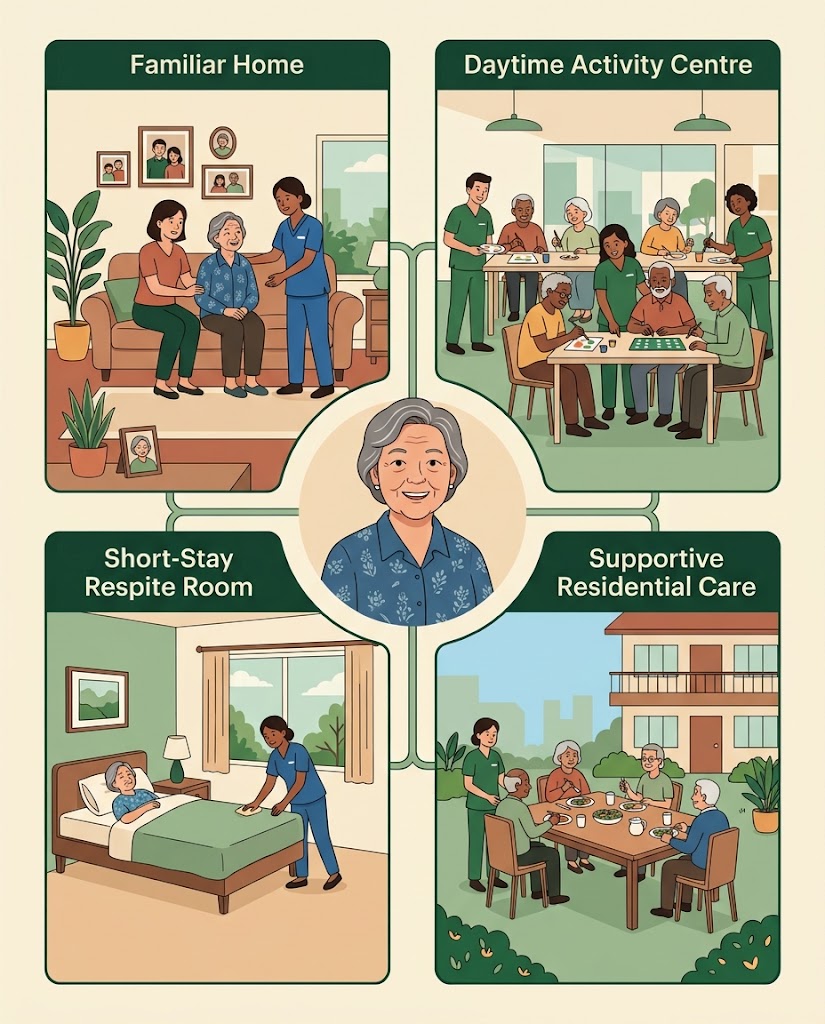
Do not treat these pathways as a ladder that everyone must climb. Moving into residential care is not a “failure”; equally, keeping someone at home is not automatically the kindest choice if safety and caregiver health are collapsing. The right plan is the one that matches real needs today and can be reviewed without shame as circumstances change.
How to decide between home, centre, respite and residential care
1. Can your parent be safe at home between care visits?
Home care is often most workable when the home is familiar, the person can still be supported safely between visits and the family has a credible plan for gaps. “Credible” means more than hope. It identifies who will respond to a fall, what happens if a parent becomes distressed at 2am, how medication is managed and whether exits, kitchen appliances and bathrooms have been considered.
Home Personal Care is not the same as a live-in family caregiver. It is a scheduled service. Ask for the exact tasks, duration, frequency, whether the same carers can usually be assigned and what happens when a visit is changed. If there are clinical needs, ask whether home nursing or medical care should be discussed with the care team rather than assuming a personal-care service covers it.
2. Would a daytime routine reduce risk or stress?
Day care can help when the hardest period is the working day. AIC says day care supports people who need supervision, with meals, basic nursing/health services, help with personal care, activities and maintenance exercise. Selected centres provide dementia day care for people with mild to advanced dementia, including group and personalised activities and daily-living support. AIC: Day Care
For some parents, a centre provides meaningful social contact and a routine that is difficult to recreate at home. For others, an unfamiliar environment or shared transport may initially feel unsettling. A trial visit and a frank conversation about the person’s triggers, language, hearing, mobility, continence and eating needs are more valuable than a glossy brochure.
3. Is the real need a temporary break?
Respite is planned short-term care that gives a caregiver time to rest, attend to health, manage a family event or prevent a fragile situation from becoming a crisis. It is not only for emergencies. AIC describes respite options in the community and notes that nursing-home respite is a stay-in option for people dependent on caregivers for daily care needs. AIC: Take a Break
Ask early. Availability can be limited and a first stay tends to go better when the family has time to share routines, medical information, preferences, comfort items and communication needs. A planned respite stay can also help a family understand whether a longer-term residential option might be appropriate—without presenting it as a test the parent can “pass” or “fail.”
4. Is 24-hour residential support now necessary?
Residential nursing-home care deserves careful consideration when your parent needs substantial help with most activities of daily living, daily nursing support, continuous supervision, or cannot safely be cared for at home by family, caregivers or available services. MOH describes nursing homes as long-term residential care settings for residents who need help with most activities of daily living and/or daily nursing care, and who have no family support to provide that care at home. Some homes also offer short-term respite. MOH: Intermediate and Long-Term Care Services
If dementia-specific support is important, ask the home exactly how it supports people with dementia—not simply whether it has “dementia care.” AIC notes that homes specialising in dementia or psychiatric conditions may run programmes and activities intended to support residents. AIC: Nursing Home Ask about staffing, how distress is responded to, activities, family communication, medical escalation, falls prevention, restraint-free practice, cultural and language needs, and how the home handles an adjustment period.
When each option may fit
Home-based support may fit when
- your parent wants to remain at home and the environment can be made safer;
- care needs can be covered by a workable mix of family, paid support and health services;
- there is a realistic plan outside scheduled visits, including nights and weekends;
- travel to a centre is difficult or disruptive; and
- the caregiver has regular relief, not just an intention to “cope somehow.”
It may be less suitable if dangerous wandering, repeated falls, severe overnight disruption, complex unmanageable care needs or caregiver burnout make the home situation unsafe. Those are signals to ask the healthcare team for an assessment, not grounds for self-blame.

Dementia day care may fit when
- your parent needs companionship, activity or supervision during the day;
- family members work, need daytime relief or need a reliable routine;
- a centre can accommodate mobility, continence, dietary, communication and behavioural needs; and
- transport and transition into the programme are manageable.
Some families use day care a few days each week at first. Use the trial period to observe not only whether your parent participates, but also the before-and-after effect: are mornings more difficult, is sleep affected, is the person calmer with routine, and is the caregiver actually getting restorative time?
Respite may fit when
- the caregiver needs a defined break or recovery period;
- a domestic helper is on leave, a family member is travelling, or a temporary gap has appeared;
- the family wants to plan before fatigue becomes a safety issue; or
- a person is waiting for longer-term care arrangements and needs interim support.
Residential care may fit when
- care needs are beyond what the household can safely provide;
- there is a clear need for 24-hour assistance, daily nursing support or close supervision;
- the main caregiver is ill, overwhelmed or unable to continue sustainably; or
- a hospital team, doctor or medical social worker has assessed that home is not a safe discharge destination without much more support.
Residential care should still preserve the person’s identity. Bring photos, familiar music, religious or cultural preferences, preferred name, calming approaches, food preferences and a short life story. Family involvement remains meaningful after a move.
Choosing a dementia day care centre
Centres can look alike on paper. These are the differences that matter.
What to compare between centres
| What to check | Why it matters |
|---|---|
| Dementia day care, not just day care | Not every senior care centre offers it. Of the 163 centres ElderSG lists, 148 do. Ask the centre to confirm. |
| Stage of dementia | AIC says it serves mild to advanced dementia, but each centre sets its own limits. Ask whether it can keep your parent as needs change. |
| Days and hours | Most run on weekdays only; some add weekends. Check opening and closing times against your work hours. |
| Transport | Usually extra (AIC). Ask whether they serve your area and how long the ride takes. |
| Nursing and rehab on site | Is a nurse on site? Is maintenance exercise or therapy part of the day? |
| Language and diet | Your parent will settle faster with staff who speak their language or dialect. Check halal, vegetarian, soft or diabetic meals. |
| Staffing and approach | How many staff per group? Will the same staff work with your parent most days? |
| Wandering and sundowning | How are exits secured? How do staff handle late-afternoon restlessness? |
| Trial and settling in | Can you book a trial day, and can a family member stay for the first visit? |
What dementia day care costs
AIC says dementia day care starts from $63 a session before subsidy. Transport is charged on top. AIC: Day Care
Since 1 July 2026, MOH subsidies for non-residential long-term care, including dementia day care, go up to 95% for Singapore Citizens born in 1969 or earlier, 80% for other Citizens and 55% for Permanent Residents. The rate depends on household income per person, or your home’s Annual Value if no one earns an income. It applies at government-funded providers. MOH: Subsidy framework for non-residential long-term care services
Ask each centre for a written monthly estimate after subsidy, including transport.
How to get a place
- Through a doctor: a doctor at a hospital or polyclinic can submit the application online.
- Through AIC: visit an AIC Link or call the AIC hotline on 1800-650-6060.
A short visit checklist
Use these on top of the provider questions further down.
- Can I see the room where my parent would spend most of the day?
- Which staff speak my parent’s language or dialect?
- What time is pick-up, and what time does my parent get home?
- What happens if I am late to collect my parent?
- How will you tell me about falls, refusals or a bad day?
- How much notice do you need to change days or stop?
Signs day care is no longer enough
Day care may no longer be enough if your parent is unsafe at night, the centre can no longer meet their needs, or the caregiver is exhausted despite it. Respite can buy time to plan: read Respite Care for Elderly Parents in Singapore. If your parent needs care around the clock, see ElderSG nursing home listings.
A safe, practical way to make a decision

Use this five-step process over a week or two when the situation is not urgent.
- Make a one-page care snapshot. Note diagnosis or symptoms, mobility, personal-care needs, medications, communication, daily rhythm, difficult periods, health appointments, safety concerns and what brings comfort.
- Map the current week honestly. Who provides care at each time of day? Mark every uncovered hour. Include the caregiver’s sleep, work and own appointments.
- Ask for clinical and social-care guidance. Speak to the treating team, polyclinic or GP. A hospital or polyclinic medical social worker can help with referrals and affordability questions. AIC Link and AIC’s care-services information can help families identify suitable services.
- Compare two or three realistic services. Use the same questions each time. Do not compare only price, location or availability; compare whether the service can safely meet the specific needs described in your snapshot.
- Set a review date. Agree what would indicate that the plan is working, and what would trigger a change—for example, repeated falls, distress, missed work, the caregiver’s health deteriorating, or a service no longer being able to meet needs.
A simple “care circle” conversation
The parent should be included in decisions as far as possible. Keep conversations short, calm and concrete. Instead of presenting a move or programme as something being done to them, frame it around the goal: help at home, a daytime routine, a chance for the family caregiver to rest, or more support with nursing needs.
Write down who is responsible for: medical appointments, bills, provider calls, overnight cover, emergency contacts and updates to other relatives. Confusion among adult siblings can exhaust the main caregiver as much as the practical tasks do.
Questions to ask a provider
Bring a printed version of these questions to visits or calls. For a tailored list, use the ElderSG Questions-to-Ask Generator.
For home-care providers
- What tasks are included in a normal visit, and what is not included?
- Can the team support someone living with dementia? What training and approach do carers use?
- How are missed, late or urgent visits handled?
- Can you support medication reminders, personal care and mind-stimulating activities? Which tasks need nursing or medical referral?
- How will the family receive updates and raise concerns?
For dementia day-care centres
- Do you support the person’s current dementia, mobility and personal-care needs?
- What does a typical day look like, and how are activities adapted for different abilities?
- How do staff respond to distress, refusal, wandering risk or a change in health?
- Are transport, meals and personal-care support available, and what do they cost?
- Can we visit, arrange a trial, or speak to the care lead before enrolment?
For respite or nursing homes
- Is the home licensed, and can it meet this person’s nursing and dementia-care needs?
- How are families contacted after a fall, medical change or transfer to hospital?
- What staffing and activities support residents living with dementia?
- What personal items, medication records and documents are required for admission?
- What are the costs, subsidies, deposit terms and items charged separately? Please put these in writing.
Use the Care Decision Navigator to organise your answers before comparing listings. A listing should help you start a conversation, not replace a provider’s current confirmation of availability, eligibility or price.
Costs, subsidies and how to get help
Costs depend on the type of service, frequency, transport, care complexity, provider and subsidy eligibility. Never assume that a quoted “from” price includes transport, supplies, weekends, nursing needs or additional support. Ask for a written itemised estimate and a clear explanation of what may change.
For government subsidies for long-term care services, eligibility and means testing matter. AIC’s service pages explain the current service scope and application paths; a hospital or polyclinic medical social worker can also help families who need support with fees or applications. For day care and nursing homes, AIC states that Singapore Citizens or Permanent Residents may qualify for government subsidies, subject to relevant assessment and conditions. Check current rules rather than relying on old family advice or social-media posts. For dementia day care fees and the subsidy rates from 1 July 2026, see Choosing a dementia day care centre. For nursing-home fees and the 2026 subsidy tiers, read Nursing Home Costs in Singapore. For the referral route, read How to Apply for Subsidised Nursing-Home Care.
Useful starting points:
- Find day-care information and providers – AIC
- Find nursing-home information – AIC
- Explore caregiver breaks – AIC
- Check non-residential care subsidy rates – MOH
- Understand ILTC services – MOH
- ElderSG Subsidy Application Checklist
- ElderSG Dementia Care Planner
- Home Care vs Nursing Home in Singapore
Frequently asked questions
Is dementia day care only for people with severe dementia?
No. AIC says selected dementia day-care centres support people with mild to advanced dementia. Whether a particular programme fits depends on the person’s needs and the provider’s capacity, so ask the centre directly and share a concise care snapshot.
Can a person with dementia remain at home?
Often, yes—when home is safe and there is enough practical support. A sustainable plan includes the hours between services, overnight needs, medical follow-up and the caregiver’s own limits. It should be reviewed when needs change.
Is respite care only for emergencies?
No. Planned respite is a proactive form of caregiver support. It can cover a caregiver’s rest, medical appointment, work commitment or temporary loss of help. Earlier planning gives you more choice than waiting for an emergency.
When should we consider a nursing home?
Consider it when home is no longer safe or sustainable, when there is a need for substantial ongoing assistance or nursing care, or when caregiver capacity has genuinely been exhausted. A clinician or medical social worker can help assess the situation and discuss referral options.
What if my parent refuses help or a centre?
Start with the concern behind the refusal: unfamiliar people, fear of losing independence, transport, language, embarrassment or a bad prior experience. Introduce one small change, involve the person in decisions where possible, and discuss sudden behavioural changes with a doctor. Avoid arguing about memory or forcing a decision during a moment of distress.
How do we choose between two providers?
Compare the provider’s fit with the person’s actual needs, not only its location or advertised programme. Ask both providers the same questions about staffing, care approach, communication, emergency response, costs, transport and availability. Confirm any important promise in writing.
What to do next
- Complete the Care Decision Navigator with one family member.
- Discuss urgent safety or health changes with a doctor, polyclinic or hospital care team.
- Search ElderSG Dementia Care listings and compare services by location and type.
- If you need a break now, read Respite Care for Elderly Parents in Singapore, explore respite options through AIC and speak to a provider early.
- Review the plan in two to four weeks, rather than treating the first choice as permanent.
Sources
This guide was written for Singapore families using current public information from the Ministry of Health and the Agency for Integrated Care. It explains service pathways, not clinical eligibility, diagnosis, provider quality or availability. Links were checked on 5 October 2026. Day care fees and subsidy rates were checked on 16 November 2026.
Primary sources:
- Ministry of Health: Intermediate and Long-Term Care Services
- Ministry of Health: Caregiving
- Agency for Integrated Care: Day Care
- Agency for Integrated Care: Take a Break
- Agency for Integrated Care: Nursing Home
- Ministry of Health: Subsidy Framework for Non-Residential Long-Term Care Services
Independence and commercial disclosure
ElderSG is free for families. Some providers may later pay for clearly labelled featured profiles or enquiries shared with your consent. Such commercial arrangements do not determine the care options explained in this guide. Families should verify current availability, eligibility, fees and service suitability directly with providers and the relevant public agencies.