Short answer
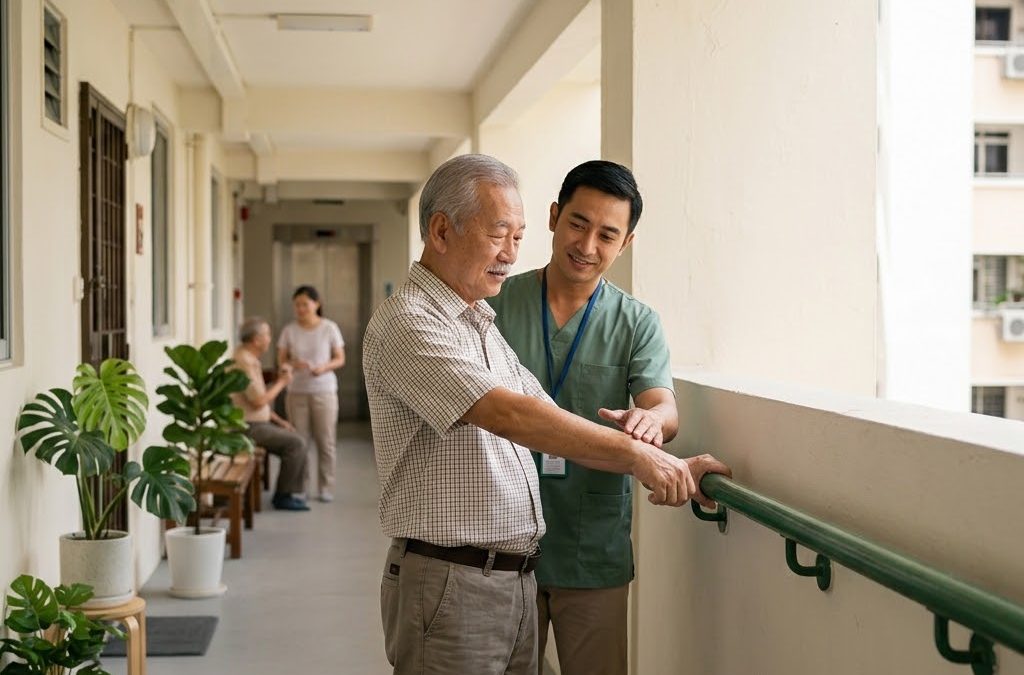
Rehabilitation helps an older person regain or maintain the ability to manage daily life after illness, injury, surgery or a decline in function. In Singapore, the setting may be a community hospital, community/day rehabilitation centre, hospital outpatient service or home therapy. The best setting depends on medical stability, goals, travel ability, home safety and whether the family can support practice between sessions.
Important: Rehabilitation plans must be set by the treating healthcare team. This guide helps families ask better questions; it does not diagnose a condition, prescribe exercises or promise recovery.
What families mean by “rehab centre”
When an adult child searches for a rehabilitation centre, they may be looking for very different things: a place for a parent after a stroke, therapy after a hip fracture, support after a hospital stay, or exercises for a frail senior who is falling more often. The right answer is not always an inpatient centre.
Rehabilitation aims to optimise function and reduce disability so that a person can do more of their daily activities and reintegrate into home or another care setting. MOH says community hospitals provide rehabilitative and subacute care after acute hospital treatment, for conditions such as stroke, brain injury, Parkinson’s disease, fractures and joint replacements. MOH: Community Hospitals
Community rehabilitation centres provide physiotherapy and speech therapy for seniors recovering their ability to move, speak or swallow after conditions such as stroke, heart conditions or fractures. AIC: Community Rehabilitation
The four main rehabilitation pathways
| Setting | What it is for | May fit when | Family question |
|---|---|---|---|
| Community hospital | Inpatient rehabilitative or subacute care after acute treatment | Person still needs inpatient nursing/medical oversight and daily rehabilitation | “Why is inpatient rehab needed before home?” |
| Community/day rehabilitation | Therapy at a centre, with the person travelling from home | Parent can travel safely and work towards specific functional goals | “What goals and therapy disciplines are included?” |
| Hospital outpatient therapy | Hospital-based follow-up therapy | Specialist follow-up or hospital programme is appropriate | “Can transport and attendance be sustained?” |
| Home therapy | Rehabilitation delivered at home | Parent is home-bound or travel would be unsafe or overly difficult | “Can therapy goals be achieved in our actual home environment?” |
MOH says community rehabilitation and home therapy can include physiotherapy and occupational therapy for conditions that affect daily activities, such as stroke, fractures, lower-limb amputation and some mental-health conditions. MOH: ILTC Services
Community hospital rehabilitation
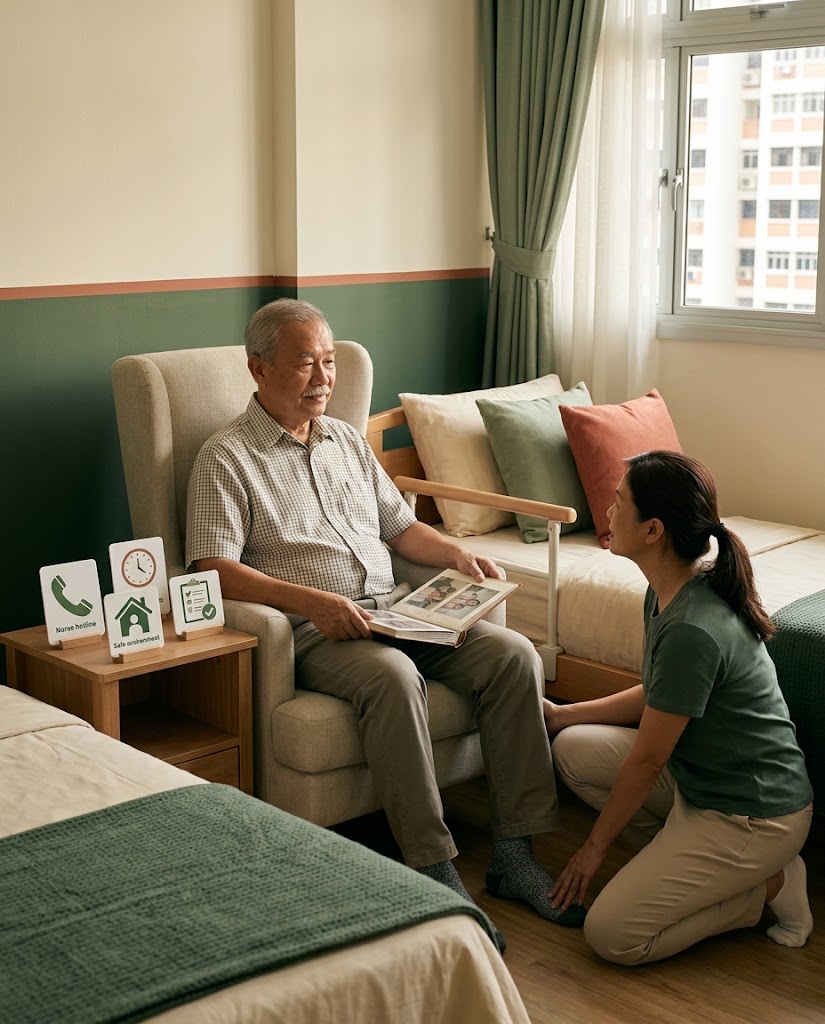
A community hospital is not simply a nursing home or a holding place after an acute hospital. It is an intermediate inpatient facility for people who need convalescent rehabilitation or subacute care. MOH says the length of stay may range from a few days to a few weeks depending on condition. MOH: Community Hospitals
Ask the team:
- What are the rehabilitation goals before discharge?
- Which daily activities should improve, and what level of assistance is expected at home?
- Which therapies are planned: physiotherapy, occupational therapy, speech therapy or another service?
- What caregiver training is required?
- What equipment or home changes must be arranged before discharge?
- What is the next setting after the community hospital?
If your parent is moving from an acute hospital, also read What to Do When a Parent Is Discharged From Hospital and use the Hospital Discharge Planner.
The most useful outcome is not a number of therapy sessions. It is a workable transition: safe transfers, a manageable toileting plan, enough mobility for the actual home, and a family that knows how to provide support without injuring themselves.
Community and day rehabilitation
Community rehabilitation can help a parent who is living at home but needs regular therapy to regain or maintain function. It may be offered at a community rehabilitation centre or a Senior Care Centre (see Senior Care Centres in Singapore). MOH notes that SCCs can offer community rehabilitation, and transport may be available for clients needing help to commute. MOH: Care Services
AIC lists active rehabilitation at community rehabilitation centres from S$55 per session and maintenance rehabilitation from S$56 per session, both before subsidies, with transport at an additional cost. Treat this as a current starting-point figure, not an expected bill; therapy, transport, subsidy eligibility and care plan vary. AIC: Community Rehabilitation
Before enrolling, ask for concrete goals. “Stronger legs” is too vague. Better examples are: transfer from bed to chair with one person, safely walk from bedroom to toilet, manage a step at the front door, use a handrail, prepare a simple drink, or communicate needs more clearly. The treating therapists should decide appropriate goals.
Home therapy
Home therapy brings rehabilitation to people who are home-bound or struggle to travel. AIC lists home therapy from S$125 per visit before subsidies; Singapore Citizens and PRs may qualify for means-tested subsidies. AIC: Home Therapy For other services at home, such as home nursing and personal care, see Home Nursing and Home Personal Care in Singapore.
Home therapy’s advantage is realism. A therapist can see the actual bathroom threshold, bed height, corridors, lift access, footwear and chair that the person needs to use. It can be particularly valuable when a parent’s main obstacle is navigating their own home safely.
Its limitation is that home therapy remains scheduled. Families should ask what practice is safe between visits, who will supervise it, and how progress will be reviewed. Never improvise exercises copied from the internet if they contradict the clinician’s instructions.
How to choose the setting
Use five questions with the medical team:
- Medical stability: Does my parent need inpatient nursing or medical observation?
- Mobility and transport: Can they travel safely and tolerate the journey?
- Functional goal: What is the specific activity we are trying to regain or maintain?
- Home context: Is the main challenge visible only at home?
- Caregiver capacity: Can the family provide safe support and regular practice between sessions?
Speaking in July 2026, Minister of State Rahayu Mahzam said the aim is for patients to receive rehabilitation in the setting most appropriate for their needs, whether a polyclinic, a community care organisation or their own home. She also noted that patients with non-surgical musculoskeletal conditions, total knee replacements and mild strokes achieved comparable outcomes in primary and community care. MOH: Physiotherapy Congress speech
A family checklist for the first rehabilitation appointment
- Bring discharge summaries, medication list, relevant imaging/clinic information and mobility aids as instructed.
- Explain the actual home layout and daily routine, including stairs, bathroom configuration and bed height.
- State the person’s priorities: returning to a familiar chair, walking to a food court, dressing independently, speaking more clearly, eating safely or reducing falls.
- Ask what support is safe at home and what the family must not attempt.
- Ask how progress will be measured and when the plan will be reviewed.
- Ask what happens if the person misses sessions because of illness, transport or caregiver constraints.
Costs, subsidies and access
For subsidised community-care services, families can approach the doctor at the hospital or polyclinic, or visit an AIC Link for help with application. MOH: Care Services
Community rehabilitation and home therapy fall under MOH’s subsidy framework for non-residential long-term care. Singapore Citizens born after 1969 can receive up to 80% subsidy, citizens born in 1969 or earlier up to 95%, and Permanent Residents up to 55%, depending on household monthly income per person (or the Annual Value of the home when there is no household income). MOH: Non-Residential LTC Subsidies HealthHub: ILTC Subsidies
Community hospital stays are billed as inpatient care. Ask the hospital’s financial counsellor for an estimate that shows the subsidised rate and how MediSave and MediShield Life apply.
MediSave can be used for day rehabilitation: up to S$25 per rehabilitative service per day, capped at S$1,500 a year. Confirm with the provider how this applies to your parent’s bill. MOH: Long-Term Care and MediSave
Questions to ask a rehabilitation provider
- Which therapy disciplines will assess and treat my parent?
- What goals are appropriate over the next four to eight weeks?
- How does the programme connect therapy exercises to daily activities?
- Is transport available, and can the person travel safely?
- What caregiver training and home practice are expected?
- How will falls, pain, fatigue or a sudden health change be handled?
- What are the full costs, including transport and assessment, before and after confirmed subsidies?
- How will the referring doctor and family receive progress updates?
Frequently asked questions
Is a community hospital the same as a rehabilitation centre?
Not exactly. A community hospital provides inpatient rehabilitative and subacute care. A community rehabilitation centre is generally a centre-based outpatient/community service. The appropriate setting depends on stability and care needs.
Can my parent have rehabilitation after a stroke at home?
Possibly. HealthHub notes that therapy after discharge may continue in hospital outpatient clinics, day rehabilitation centres or home-based therapy. Suitability must be decided by the treating team. HealthHub: Stroke Occupational Therapy
How much does rehabilitation cost in Singapore?
Before subsidies, AIC lists community rehabilitation from S$55 per session and home therapy from S$125 per visit; transport is extra. Means-tested subsidies of up to 80% (95% for citizens born in 1969 or earlier, 55% for PRs) can reduce this, and MediSave can cover up to S$25 per rehabilitative service per day for day rehabilitation, within S$1,500 a year.
How do we apply for community rehabilitation or home therapy?
Ask the doctor or therapist at the hospital or polyclinic to submit the application, or visit an AIC Link. You can also call AIC on 1800 650 6060.
Does more therapy always mean better recovery?
Not necessarily. A safe, targeted plan that the person can participate in and practise appropriately is more useful than an unsustainable schedule. The clinical team should set frequency and goals.
What if my parent refuses therapy?
Ask what is behind the refusal: pain, fear of falling, fatigue, depression, poor communication, transport stress or a goal that does not feel meaningful. Share this with the therapist; do not frame it as laziness. If low mood or memory problems are part of the picture, see Dementia Care Options in Singapore and ask the doctor for an assessment.
What to do next
- Ask the treating team which setting matches your parent’s current stability and goals.
- Create a short functional-goal list with your parent.
- Search ElderSG rehabilitation listings by location, setting and transport need.
- Ask about application, subsidy and transport pathways through the hospital, polyclinic or AIC Link. The Questions-to-Ask Generator can prepare you for the meeting.
- Review the plan when home circumstances or caregiver capacity change.
Sources
- Ministry of Health: Community Hospitals
- Ministry of Health: Intermediate and Long-Term Care Services
- Ministry of Health: Care Services
- Ministry of Health: Subsidy Framework for Non-Residential Long-Term Care Services
- Ministry of Health: MediSave for Long-Term Care
- Ministry of Health: Speech at the Singapore-International Physiotherapy Congress 2026
- Agency for Integrated Care: Community Rehabilitation
- Agency for Integrated Care: Home Therapy
- HealthHub: Subsidies for Intermediate and Long-Term Care
- HealthHub: Stroke Occupational Therapy
Editorial methodology and independence
This guide uses current public information from MOH, AIC and HealthHub, checked on 5 October 2026. It does not prescribe rehabilitation or guarantee suitability, outcomes, provider availability or subsidies. ElderSG is free for families; any future featured profile or consent-based enquiry will be visibly labelled and will not determine editorial recommendations.