
Short answer
A will lets a person set out how they want their estate dealt with after they die and name an executor to carry out those instructions. In Singapore, the person must be at least 21, and the will must be in writing, signed by them and witnessed by two people present at the same time; a gift to a witness or the witness’s spouse fails. CPF savings are not covered by a will: they follow a CPF nomination. A will is not a document for making healthcare or financial decisions while someone is alive, and it does not replace an LPA, an Advance Care Plan (ACP), or a CPF nomination. For many families, the useful first step is not choosing a template—it is having a calm conversation, making an accurate list of assets and responsibilities, and getting legal advice where the family situation is not straightforward.
Important: This guide is general educational information for Singapore. It is not legal advice and should not be used as a substitute for advice from a Singapore-qualified lawyer. The law, asset ownership arrangements and individual family circumstances matter. A will should be reviewed and formally checked before anyone relies on it.
Who should consider making a will?
Most adults with assets, people they wish to provide for, or clear preferences about who should manage their estate should consider a will. A will can help a person record how assets are to be distributed and appoint an executor to administer the estate. If a person dies without a will, their estate is generally distributed under the Intestate Succession Act rather than a personal plan; the statutory outcome may not match what the family expected or wanted. MyLegacy: Is a will required?
For an older parent, a will can be one part of a wider planning conversation. The LPA, ACP and Will Explainer shows how the documents fit together. The other parts may include an LPA for a possible future loss of mental capacity, an ACP for care preferences, a CPF nomination, insurance nominations and practical information on where original documents are stored.
A gentle way to start the conversation
“We need to talk about your will” can feel abrupt. A better opening is often: “If something happened, what would make things easier for the family? Who would you trust to handle paperwork, and where should we look for important documents?” The purpose is not to take control away from a parent. It is to help them express their own decisions while they can do so freely and understand the choices.
Let the parent lead. Adult children can help with organisation—such as compiling a list of accounts, policies, property documents and professional contacts—but should not pressure a parent about who should receive what. If a parent appears confused, is unwell, or there is tension among family members, pause and seek appropriate legal advice rather than trying to resolve it informally.
What a will does—and what it does not do
What a will can do
A will commonly:
- names an executor, the person or people asked to administer the estate;
- states who should receive particular assets or shares of the estate;
- records instructions for the distribution of assets that form part of the estate;
- may address guardianship wishes for young children; and
- can reduce uncertainty by putting the person’s instructions in one clear document.
After a death, the executor may need to obtain a Grant of Probate before dealing with estate assets. Singapore Courts’ Probate eService identifies a certified true copy of the deceased’s will as one of the documents needed for a Grant of Probate application. Singapore Courts: Probate eService This is why preserving the original and telling the executor where it is kept are practical—not merely administrative—steps.
What a will does not do
A will takes effect only after death. It does not authorise someone to manage bank accounts, make medical decisions or sell property while the maker is alive. It also may not control every item the family thinks of as an “asset”. Assets held jointly, assets with valid nominations, trust assets, certain insurance proceeds and CPF savings can follow separate legal arrangements. A lawyer can explain how a specific asset is likely to pass.
Do not make promises such as “the will covers everything.” The safer message is: a will is central, but it needs to be coordinated with the way each asset is owned and with other planning documents.
Will, LPA, ACP and CPF nomination: four different jobs
Families often discover these documents at a stressful time and assume that one can substitute for the others. They cannot. The simplest way to remember the distinction is by when each document is used and what it covers.
| Document | Main purpose | When it matters | Key family question |
|---|---|---|---|
| Will | States wishes for estate administration and distribution after death | After death | Who should administer the estate and receive estate assets? |
| Lasting Power of Attorney (LPA) | Lets a chosen donee make decisions within the LPA’s scope if mental capacity is lost | During life, if capacity is lost | Who is trusted to make personal welfare and/or property and affairs decisions? |
| Advance Care Plan (ACP) | Helps a person discuss and document values and preferences for future care | During life, especially when care decisions arise | What matters most to the person if health worsens? |
| CPF nomination | Directs the distribution of CPF savings on death | After death | Who should receive CPF savings, and in what shares? |
CPF Board states that CPF savings cannot be included in a will because they do not form part of the estate. Without a CPF nomination, the savings go to the Public Trustee’s Office, which distributes them under intestacy laws (or under the Muslim Inheritance Certificate for Muslim members) after deducting administrative fees; this can take up to six months. Making a CPF nomination is free and needs two witnesses who are not nominees. Marriage revokes an existing CPF nomination; divorce does not. CPF Board: Making a CPF nomination See CPF Matters for Older Parents in Singapore for the wider CPF check-in.
Practical family rule: keep a one-page document register. List the document name, date, original location, adviser’s contact details and the person who knows where to find it. Do not put passwords, NRIC numbers or account balances into a shared family chat.
Who can make a will in Singapore?
MyLegacy’s current guidance says a person making a will should be 21 or above, be of sound mind, and make the will voluntarily rather than under pressure. MyLegacy: Write a will The Wills Act 1838 sets the formal rules: a will made by anyone under 21 is not valid, and a will must be in writing, signed by the person making it and attested by two witnesses present at the same time. Singapore Statutes Online: Wills Act 1838
This is an area where the details matter. A signed-looking document is not automatically a reliable will. The method of signing, witnesses, capacity, possible pressure from others, the wording used and later changes can all become important. If a parent has dementia (see Dementia Care Options in Singapore), a serious illness, reduced ability to communicate, substantial assets, a complex family situation, or wishes that may surprise relatives, arrange independent legal advice early. The lawyer can assess the circumstances, explain the options and advise on the appropriate evidence and process.
The people named in a will
The person making the will
This is the person whose wishes are being recorded. Their wishes—not those of a spouse, child, caregiver or adviser—must be the basis of the document.
The executor
An executor is named to manage the estate after death. The role can involve locating the original will, identifying assets and liabilities, applying for probate where needed, paying valid debts and expenses, communicating with beneficiaries, and distributing the estate according to the will and applicable law. It can be time-consuming. Ask the person first; do not assume an eldest child wants or is able to do it. Naming a replacement executor is often sensible.
Beneficiaries
Beneficiaries are the people or organisations intended to receive assets or a share of the estate. Clarity is kind. Full legal names, relationships and unambiguous descriptions reduce avoidable questions later. A lawyer can advise on wording where a beneficiary is a minor, has special needs, lives overseas, is not a family member, or where the plan is unequal.
Witnesses
Witnessing is a legal formality, not a casual signature request. Under section 10 of the Wills Act, a gift in the will to a witness, or to the witness’s husband or wife, is void, although the will itself remains valid. Singapore Statutes Online: Wills Act 1838 Do not improvise this part from an online article or ask a named beneficiary to “just sign as witness” without legal advice.
A practical seven-step process for making a will
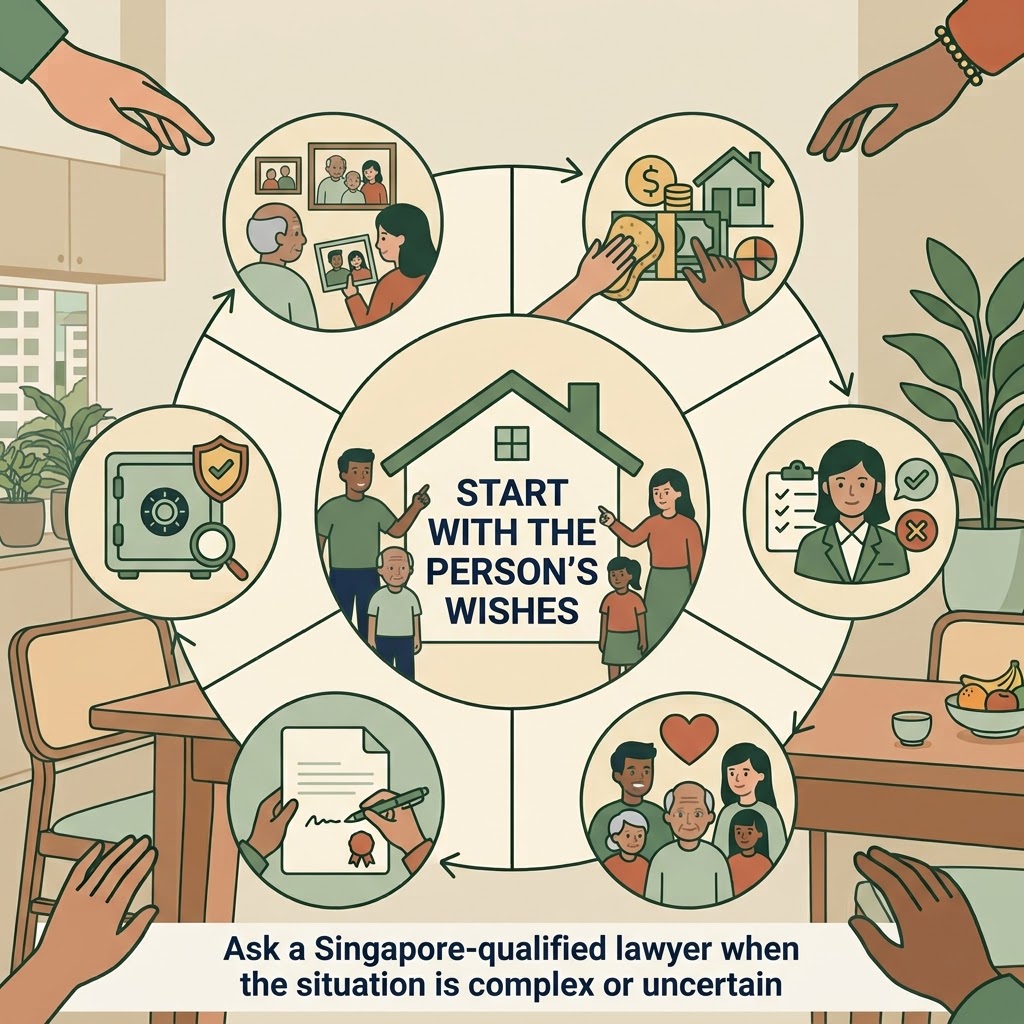
1. Make an estate-planning inventory
Start with a working list, not a polished document. Include:
- real property and how it is owned;
- bank and investment accounts;
- insurance policies and existing nominations;
- CPF savings and the status of any CPF nomination;
- vehicles, business interests, valuable personal belongings and digital assets;
- loans, guarantees, taxes and other liabilities;
- documents already made: LPAs, ACPs, prior wills and trust documents; and
- the location of originals, safe-deposit arrangements and professional contacts.
This list is for planning. It does not decide legal ownership. For example, a jointly held home may not pass under a will in the way the family assumes. Mark uncertain items “confirm with lawyer” rather than guessing.
2. Identify the parent’s aims before discussing percentages
Ask questions that reveal the objective:
- Who should be protected or provided for?
- Are there caregiving needs, a dependent adult, young children or a family business?
- Is equal treatment the goal, or is there a reason for a different arrangement?
- Who is trusted to handle paperwork fairly and calmly?
- Are there items of sentimental importance that should be specifically discussed?
The answers help a lawyer see issues that a simple asset list misses. They also make it less likely that the family treats estate planning as only a financial exercise.
3. Choose an executor thoughtfully
Choose for reliability, availability and willingness—not simply birth order. Consider whether the person is organised, can remain neutral during disagreement, and is likely to be in Singapore or able to manage the work. Discuss whether a second executor or professional support may be appropriate. The right choice varies by family; there is no universal “best” child.
4. Get independent legal advice when it is needed
MyLegacy offers a Will Learning Tool and a will-preparation template as an educational starting point. MyLegacy: Will Learning Tool A learning tool can help a family prepare questions, but it cannot assess whether a particular plan is legally effective for their facts. Seek a Singapore-qualified lawyer especially if there are overseas assets, a blended family, a business, a property with co-owners, a planned exclusion of a close family member, a vulnerable beneficiary, a prior will, a trust, a Muslim estate, or concerns about capacity or family pressure.
The person making the will should have the chance to speak privately with the lawyer. This protects the parent’s autonomy and reduces the risk that a later dispute focuses on influence from relatives.
5. Sign using the correct formalities
Do not treat this as a final-minute formality. Follow the lawyer’s instructions exactly, including the required signing and witnessing arrangements. Keep the appointment calm and free from interruptions. If the person’s health or capacity is changing quickly, tell the lawyer before the meeting rather than waiting until afterwards.
6. Store the original safely—and make it findable
Ask the lawyer where the original should be kept. If it is stored at home, use a secure location protected from loss, water and unauthorised access. Tell the executor where it is kept and who to contact; do not hand out unnecessary copies of sensitive financial records. A family can also record the location in the document register.
7. Review after major life changes
Marriage revokes an existing will under section 13 of the Wills Act, so a new will is usually needed after marriage, including remarriage later in life. Singapore Statutes Online: Wills Act 1838 Put a calendar reminder to review the will after other major changes too: a marriage, divorce, death of an executor or beneficiary, birth of a child or grandchild, diagnosis or disability affecting a beneficiary, purchase or sale of property, new business ownership, move overseas, or a large change in family circumstances. Do not make handwritten amendments or assume that a verbal family agreement updates a will. Seek legal advice before changing anything.
Common mistakes that create difficult work later
“Our parent already told us what they want.”
Family conversations are valuable, but informal statements can be misunderstood or forgotten. A properly prepared will gives the executor a document to work from. It should be the parent’s decision, made freely.
“The eldest child will naturally handle it.”
The role needs consent, time and judgement. Naming an executor and an alternative avoids unnecessary uncertainty. Consider whether the relationship dynamics make a single family executor difficult.
“The will automatically covers CPF and every account.”
It may not. CPF nomination is a separate planning item, and other assets can have their own ownership or nomination rules. Keep a coordinated checklist and get advice on exceptions.
“We can fix it after the parent loses capacity.”
This is precisely when planning may become harder. An LPA should be considered while the person has capacity (see How to Make a Lasting Power of Attorney in Singapore); a will also depends on the person making their own voluntary decisions with the required mental capacity. Do not delay a needed conversation because it feels uncomfortable.
“A free template means the family is protected.”
Educational templates can help structure thoughts, but simple wording errors or incorrect signing can create large consequences. Treat a template as preparation material, not personalised legal advice.
When a lawyer is particularly important

Arrange advice early where any of the following apply:
- the person has a dementia diagnosis, cognitive changes or communication difficulties;
- there are disagreements, estrangement, new relationships or concerns about influence;
- there are children from different relationships or dependants with special needs;
- the estate includes an HDB flat, other jointly owned property, overseas assets, a business or a trust;
- the person wants to leave a gift to a caregiver, friend, charity or someone outside the usual family circle;
- a beneficiary may need funds held or managed in a particular way;
- the person is Muslim, as Islamic inheritance law (faraid) generally applies and a will can usually deal with only up to one-third of the estate; or
- there is an earlier will, unclear ownership records or a need to revise a plan urgently.
The goal is not to make planning intimidating. It is to recognise when a generic document cannot responsibly account for the circumstances.
If a parent has died: first steps for the family
If a family member has died, locate the original will without changing, marking or removing pages. Identify the named executor and contact the law firm, if any. The executor may need a Grant of Probate to deal with the estate; Singapore Courts provides a Probate eService and sets out the documentation route. Singapore Courts: Probate eService Do not assume that being a spouse or adult child automatically gives authority to access accounts or distribute assets.
At this stage, it can help to make one secure list of known assets, liabilities, recurring payments and key documents, then obtain legal guidance before taking actions that affect the estate. Give banks, insurers and agencies only the information and documents they request through official channels. Grief creates urgency, but careful administration protects everyone.
Frequently asked questions
Is there a legal requirement to make a will in Singapore?
No. MyLegacy states that there is no legal requirement to make one. However, dying without a will generally means statutory intestacy rules determine how the estate is distributed, which may not match the person’s wishes. MyLegacy: Is a will required?
Can an adult child make a will for an elderly parent?
No. An adult child can help their parent organise information and obtain appointments, but the parent must make their own voluntary decisions and meet the legal requirements. If there are questions about capacity or pressure, consult a Singapore-qualified lawyer.
Does a will replace an LPA?
No. A will operates after death. An LPA concerns decision-making during life if the person loses mental capacity. Many families need to consider both, alongside care planning.
Does a will control CPF savings?
No. CPF Board states that CPF savings cannot be included in a will; they are distributed according to a CPF nomination or, without one, through the Public Trustee under intestacy laws. Check the parent’s nomination status separately. CPF Board: Making a CPF nomination
How many witnesses does a will need in Singapore?
Two. The Wills Act requires the will to be signed by the person making it and attested by two witnesses who are present at the same time. A witness, or the witness’s spouse, should not be a beneficiary: a gift to them is void. A lawyer can arrange suitable independent witnesses. Singapore Statutes Online: Wills Act 1838
Does marriage cancel a will in Singapore?
Yes. Under the Wills Act, marriage generally revokes an existing will, so a new will should be made after marriage. Marriage also revokes an existing CPF nomination. Singapore Statutes Online: Wills Act 1838 CPF Board: Making a CPF nomination
Where should the original will be kept?
Use a secure and known location, following the lawyer’s advice. The executor should know how to locate it and whom to contact. Avoid leaving the only original somewhere nobody can access or identify after death.
A simple family action list for this month
- Ask your parent whether they want to discuss future planning, and accept their pace.
- Create a private inventory of documents and questions—not a family vote on inheritance.
- Check whether there is an existing will, LPA, ACP, CPF nomination or insurance nomination.
- Ask the intended executor whether they are willing to take on the role.
- Book a Singapore-qualified lawyer where the situation is complex, urgent or uncertain.
- After a will is completed, record the date and original location in the family document register. The Care Decision Navigator can help keep the family’s notes in one place.
- Set a review reminder after major life changes.
Careful planning cannot remove grief, but it can make the practical burden lighter and help an older person’s voice remain central.
Sources
- MyLegacy: Write a will
- MyLegacy: Is there any legal requirement to make a will?
- MyLegacy: Will Learning Tool
- Singapore Statutes Online: Wills Act 1838
- Singapore Courts: Probate eService
- CPF Board: Making a CPF nomination
Editorial methodology and disclosure
This guide uses current official information from MyLegacy, Singapore Statutes Online, Singapore Courts and the CPF Board, checked on 5 October 2026. It is educational only and does not give legal advice or recommend a particular lawyer or will product. ElderSG does not sell legal services; any future commercial relationship will be clearly labelled and will not determine editorial recommendations.